Skip to content
Deity · Greek mythology

Silenus

Σειληνός

The old, fat and ever-drunk tutor of Dionysus, who hides a deep wisdom under his drunkenness. King Midas catches him and asks him the most important question of all.

In brief

  1. An old satyr, or 'silenus', who raised the young Dionysus and follows him everywhere. He is usually shown drunk, riding a donkey.
  2. In Ovid, Phrygian peasants find him drunk and bring him to King Midas. When Midas returns Silenus to Dionysus, the god grants him the golden touch.
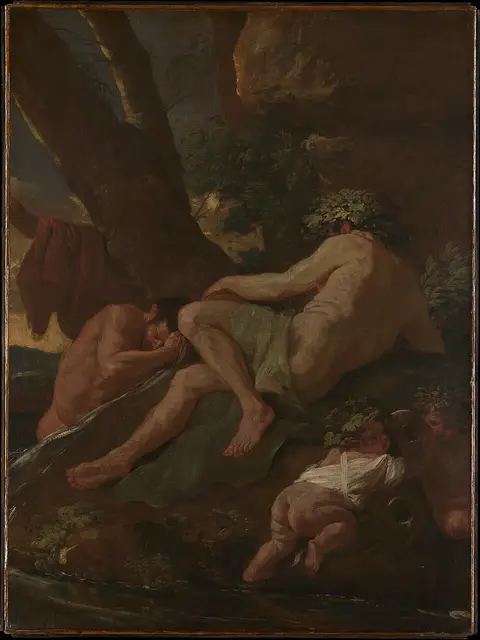
  3. In another version Midas catches Silenus by mixing wine into a spring, and asks him for his wisdom.

Family

Parents

No parents: one of the first beings.

To see the whole family, open the Silenus family tree → · how is Silenus related to Zeus? → · compare with someone else →

The wisdom of Silenus

In a story attributed to Aristotle and reported by Plutarch, Midas asks Silenus what is best for a human being. Silenus stays silent for a long time, then answers with a bitter laugh: best of all is never to have been born, and second best is to die as soon as possible.

Nietzsche used this answer in The Birth of Tragedy as the emblem of Greek pessimism and the source of tragedy.

Plutarch, Consolation to Apollonius 27

The spring in Phrygia

Xenophon writes that, passing through Phrygia, he saw near Thymbrium a spring called 'the spring of Midas', where Midas was said to have caught the satyr by mixing wine into it. Herodotus sets the episode instead in the 'gardens of Midas' in Macedonia.

In Plato's Symposium, Alcibiades compares Socrates to the little statues of Silenus that open up to reveal figures of gods inside: ugly outside, golden within.

Xenophon, Anabasis 1.2.13; Herodotus, Histories 8.138; Plato, Symposium 215a–b

Silenus in art

14works depicting Silenus, in date order, from ancient vases to paintings of the Renaissance and after. All are in the public domain or openly licensed. Click an image for the full-size version and licence details. For scene-by-scene readings of famous vases, see Greek vase painting.

Cup with stem depicting Silenus, Nikosthenes
Cup with stem depicting SilenusNikosthenes · 523 BCDepartment of Greek, Etruscan, and Roman Antiquities of the LouvreCC0 · Photo: Shonagon
Archaeological artefact depicting Silenus, Class of Athens 581
Archaeological artefact depicting SilenusClass of Athens 581 · 495 BCGiampietro Campana, Musée Saint-RaymondPublic domain · Photo: Daniel Martin
Archaeological artefact depicting Silenus, Haimon Painter
Archaeological artefact depicting SilenusHaimon Painter · 470 BCMusée Saint-RaymondCC BY-SA 4.0 · Photo: Materia Viva
satyr and Dionysos - women or maenads at the Lenaia, Hieron, Makron
satyr and Dionysos - women or maenads at the LenaiaHieron, MakronAntikensammlung BerlinCC BY-SA 4.0 · Photo: Makron
Fresco depicting Silenus
Fresco depicting SilenusNaples National Archaeological MuseumCC BY-SA 4.0 · Photo: BeakheadIntrados
Fresco depicting Silenus
Fresco depicting SilenusNaples National Archaeological MuseumCC BY-SA 4.0 · Photo: ArchaiOptix
Fresco depicting Silenus
Fresco depicting SilenusNaples National Archaeological MuseumCC BY-SA 4.0 · Photo: BeakheadIntrados
Krater depicting Silenus, Sisyphus Painter
Krater depicting SilenusSisyphus Painter · 375 BCDepartment of Greek, Etruscan, and Roman Antiquities of the LouvreCC0 · Photo: Shonagon
Bacchanal with Silenus, Andrea Mantegna
Bacchanal with SilenusAndrea Mantegna · 1458Chatsworth HousePublic domain
Misfortunes of Silenus by Piero di Cosimo, Piero di Cosimo
Misfortunes of Silenus by Piero di CosimoPiero di Cosimo · 1500Fogg Museum, Harvard Art MuseumsPublic domain
The Bacchanal of the Andrians, Titian
The Bacchanal of the AndriansTitian · 1523Camerini d'alabastro, Museo del PradoPublic domain
Silenus and king Midas, Giulio Bonasone
Silenus and king MidasGiulio Bonasone · 1600Princeton Art MuseumPublic domain
Silenus carried by satyrs, Peter Paul Rubens
Silenus carried by satyrsPeter Paul Rubens · 1600Schloss WeißensteinPublic domain
Bacchus with Silenus, Hans von Aachen
Bacchus with SilenusHans von Aachen · 1608Museum of Fine Arts, BudapestPublic domain

Stories featuring Silenus
Quick questions

What are Silenus' symbols?
Donkey, Wine cup.
Which myths is Silenus in?
King Midas.

Ancient sources

This page is based on the texts below. Numbers refer to books and lines.

  • Ovid, Metamorphoses 11.85–99
  • Xenophon, Anabasis 1.2.13
  • Herodotus, Histories 8.138
  • Plutarch, Consolation to Apollonius 27