When the Trojan War ends, Odysseus sets sail from Troy, on the Aegean coast of today’s Turkey, and needs ten more years to get home. Most of the places Homer describes belong to fairy tale, but ancient writers never stopped looking for them around the Mediterranean. The map shows those ancient and traditional guesses. Tap a stop, or move through them with the arrow keys.
Coastlines: Natural Earth (public domain). Places are ancient and traditional identifications; Homer himself leaves most of them vague.
The first stop is Ismarus, a town of the Cicones in Thrace. Odysseus’s men sack it, then stay on the beach to feast on the spoils. The Cicones regroup and attack, and every ship loses six men.
Here Odysseus spares Maron, a priest of Apollo, who gives him a very strong wine. That wine will save lives in the Cyclops’s cave.
Homer, Odyssey 9.39–66, 9.196–211
Where was it? Homer names the place, and its location is known.
Today: coast of Libya and Tunisia (tradition: Djerba)
The Lotus-eaters are peaceful people. They give Odysseus’s men the fruit of the lotus, and whoever eats it forgets about going home and wants only to stay.
Odysseus drags his weeping men back to the ships by force and ties them to the benches.
Homer, Odyssey 9.82–104; Herodotus 4.177
Where was it? Herodotus places the Lotus-eaters on the Libyan coast; later tradition points to the island of Djerba in Tunisia.
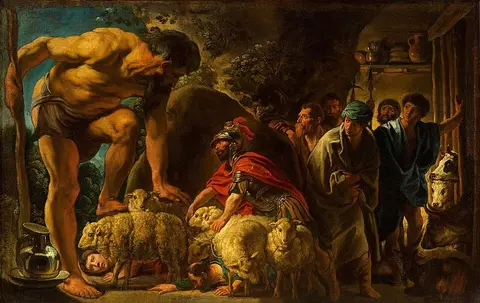
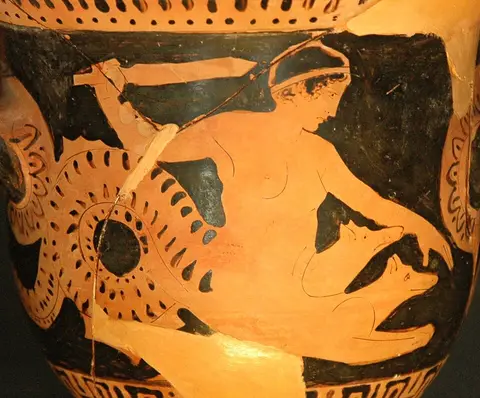
Odysseus and twelve of his men are trapped in the cave of Polyphemus, the one-eyed giant son of Poseidon. Every evening the giant eats two of them.
Odysseus tells him his name is “Nobody”, gets him drunk on Maron’s wine and drives a red-hot stake into his single eye. The men escape clinging to the bellies of rams. But Odysseus shouts out his real name as they sail away, and brings Poseidon’s anger down on himself.
Homer, Odyssey 9.105–566
Where was it? Thucydides names the Cyclopes among the oldest peoples of Sicily.
Aeolus, master of the winds, lives on a floating island. He hosts Odysseus for a month, and on parting ties up all the rough winds in an oxhide bag, leaving only the west wind free.
On the tenth day Ithaca comes into sight. Odysseus falls asleep from exhaustion, and his men, thinking the bag is full of gold, open it. The winds burst out and blow the ships all the way back to Aeolia. Aeolus sends them away, saying the gods must hate them.
Homer, Odyssey 10.1–76
Where was it? Strabo connects Aeolus with the Lipari Islands.
The Laestrygonians are man-eating giants. When the ships enter their harbour, they hurl rocks from the cliffs, smash the ships and spear the men like fish.
Odysseus has moored his own ship outside the harbour. He cuts the cable and gets away. Of the twelve ships, only his survives.
Homer, Odyssey 10.80–132
Where was it? Ancient writers put the Laestrygonians in Sicily (Thucydides) or at Formiae in Italy.
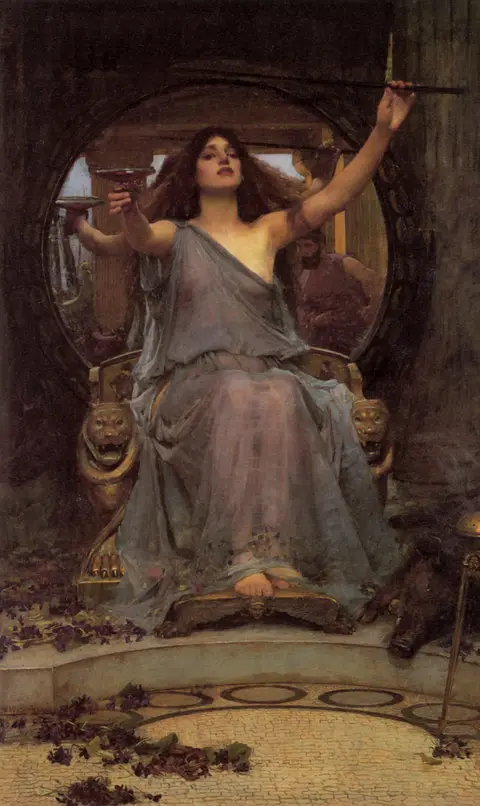
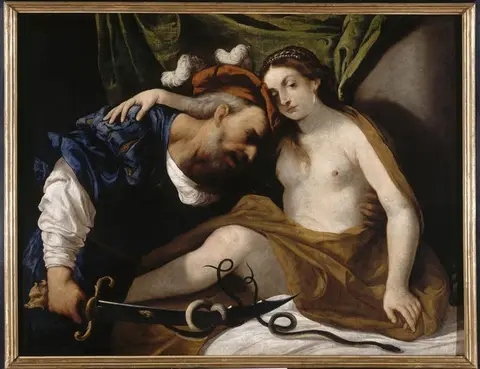
The witch Circe turns Odysseus’s men into pigs. Hermes gives Odysseus a herb called moly that protects him from her magic. Odysseus overpowers Circe and makes her turn his men back.
They stay with her for a year. Circe tells him that to learn the way home he must go to the land of the dead and consult the seer Tiresias.
Homer, Odyssey 10.133–574
Where was it? Strabo identifies Aeaea with the Circaeum promontory (Monte Circeo) on the Italian coast.
At the edge of the world Odysseus digs a pit and pours out the blood of sacrifice. The spirits of the dead come to drink. The seer Tiresias warns him not to touch the cattle of Helios, and tells him he will reach home late and alone.
He sees the spirit of his mother, Anticlea, and three times tries to embrace her; his arms close on empty air. He also meets the shades of Agamemnon, Achilles and Ajax.
Homer, Odyssey 11
Where was it? In Homer it lies at the edge of the world; later tradition points to Lake Avernus near Cumae.
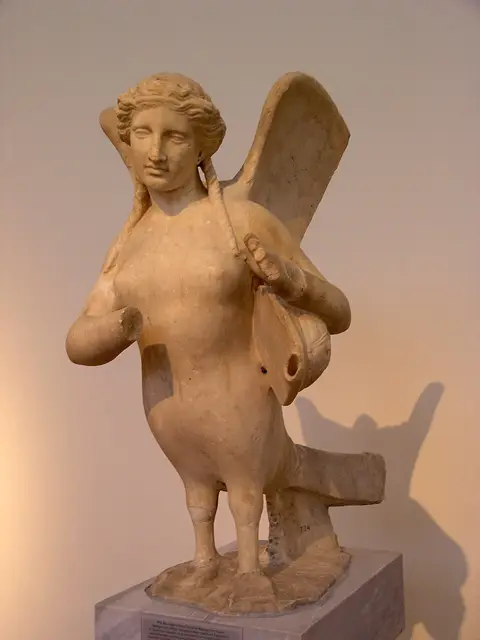
Sailors who hear the Sirens’ song are drawn to the shore and die. Following Circe’s advice, Odysseus stops his men’s ears with beeswax.
He wants to hear the song himself, so he has himself tied to the mast and orders the crew not to free him however much he begs. He hears the Sirens and lives.
Homer, Odyssey 12.39–54, 12.153–200
Where was it? Strabo places the Sirens on the Sirenussae islands off Sorrento.
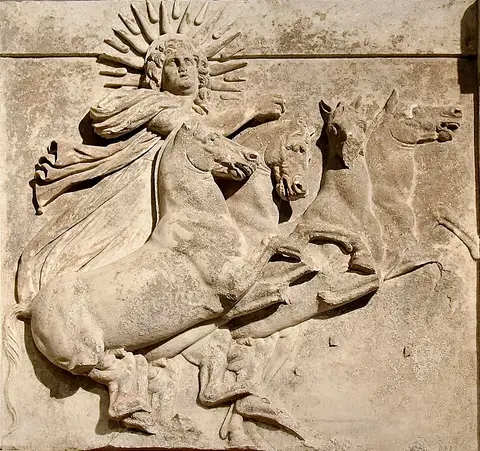
Contrary winds blow for a month and they cannot leave the island. With their food gone, the men slaughter the sacred cattle of Helios while Odysseus sleeps.
Helios demands vengeance from Zeus. Once they are at sea, Zeus shatters the ship with a thunderbolt and every man drowns. Only Odysseus, who did not touch the cattle, survives, clinging to a piece of wreckage. He is swept past Charybdis a second time.
Homer, Odyssey 12.260–453
Where was it? Ancient writers identified Thrinacia with Sicily (Trinacria).
After nine days adrift, Odysseus reaches Ogygia, the island of the nymph Calypso. She keeps him for seven years and offers him immortality.
Every day he sits on the shore weeping for home. At last, at Athena’s request, Zeus sends Hermes, and Calypso has to let him go. She helps him build a raft.
Homer, Odyssey 5.1–268, 7.244–266
Where was it? According to Strabo, Callimachus identified Ogygia with Gaudos (Gozo), near Malta.
Poseidon wrecks the raft, and Odysseus swims ashore on Scheria, land of the Phaeacians. The princess Nausicaa finds him on the beach and shows him the way to the palace.
At King Alcinous’s feast Odysseus reveals who he is and tells the story of his wanderings. The Phaeacians take him home in a ship laden with gifts and leave him, still asleep, on Ithaca.
Homer, Odyssey 5.269–13.187
Where was it? Thucydides says the Corcyraeans claimed the Phaeacians as their ancestors.
After twenty years Odysseus is home. Athena disguises him as an old beggar. He hides with the swineherd Eumaeus and is reunited with his son, Telemachus.
Penelope’s suitors hold a contest with Odysseus’s bow, and none of them can string it. The beggar strings it, shoots an arrow through the holes of twelve axe heads and turns on the suitors. In the end Penelope recognises him by the secret of their bed, which only the two of them know.