The man-eating Cyclops who traps Odysseus in his cave. Blinded by 'Nobody', he calls down the curse of Poseidon that keeps Odysseus from home for ten years.
In brief
- In the Odyssey he is the son of Poseidon and the sea nymph Thoosa. Homer's Cyclopes are not Hesiod's smiths but lawless shepherds who never plough.
- Odysseus and twelve of his men enter his cave. Polyphemus blocks the entrance with a huge rock and eats two men that evening, two the next morning and two more the next evening.
- Odysseus gets him drunk on strong dark wine and tells him his name is 'Nobody' (Outis). When the giant falls asleep they drive a red-hot olive stake into his eye. The other Cyclopes come running, but when Polyphemus shouts 'Nobody is killing me!' they go away.
Family
Parents
Homer, Odyssey 1.68–73
Siblings
½ Half-sibling: only one parent in common.
To see the whole family, open the Polyphemus family tree → · how is Polyphemus related to Zeus? → · compare with someone else →
Escape under the rams, and the curse
In the morning Polyphemus lets his flock out to pasture, feeling the back of every animal. Odysseus has tied each of his men under the middle one of three rams, and he himself clings to the fleece of the biggest ram; so they all get out. Safe on the ship, Odysseus can't resist shouting his real name. Polyphemus prays to his father Poseidon: may Odysseus never reach home, or if he must, may he come late, alone, on a stranger's ship, and find trouble in his house. The rest of the Odyssey is that curse coming true.
Homer, Odyssey 9.105–566The Cyclops in love
Later poets also made Polyphemus a comic and touching lover. In Theocritus, the young Polyphemus is hopelessly in love with the sea nymph Galatea and sings to her on the shore. In Ovid, Galatea loves the shepherd Acis; the jealous Polyphemus crushes him under a rock torn from the mountain, and Galatea turns Acis into a river in Sicily.
Theocritus, Idyll 11; Ovid, Metamorphoses 13.738–897; Euripides, CyclopsWords of Polyphemus
“Friends, Nobody is killing me by trickery, not by force!”
Our own plain translations: they keep the sense, not the exact words. Play “Who said it?” →
Polyphemus on Greek vases
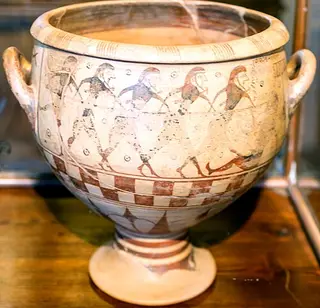
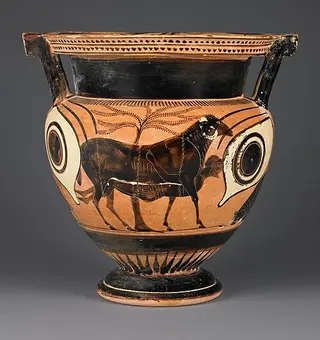
Polyphemus in art
16works depicting Polyphemus, in date order, from ancient vases to paintings of the Renaissance and after. All are in the public domain or openly licensed. Click an image for the full-size version and licence details. For scene-by-scene readings of famous vases, see Greek vase painting.


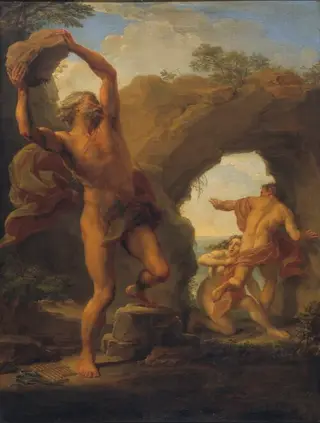

Stories featuring Polyphemus
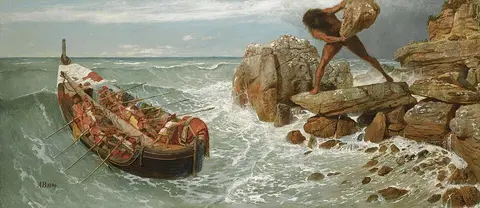
Quick questions
- Who are Polyphemus' parents?
- In the main account, Polyphemus' father is Poseidon and mother is Thoosa. Homer, Odyssey 1.68–73
- What are Polyphemus' symbols?
- Single eye, Flock of sheep.
- Which myths is Polyphemus in?
- Odysseus and Polyphemus.
Ancient sources
This page is based on the texts below. Numbers refer to books and lines.
- Homer, Odyssey 1.68–73, 9.105–566
- Euripides, Cyclops
- Theocritus, Idylls 6 and 11
- Ovid, Metamorphoses 13.738–897