Skip to content
Monster · Greek mythology

Pegasus

Πήγασος

The winged horse who springs from Medusa's neck. Bellerophon tames him with a golden bridle and rides him against the Chimera.

In brief

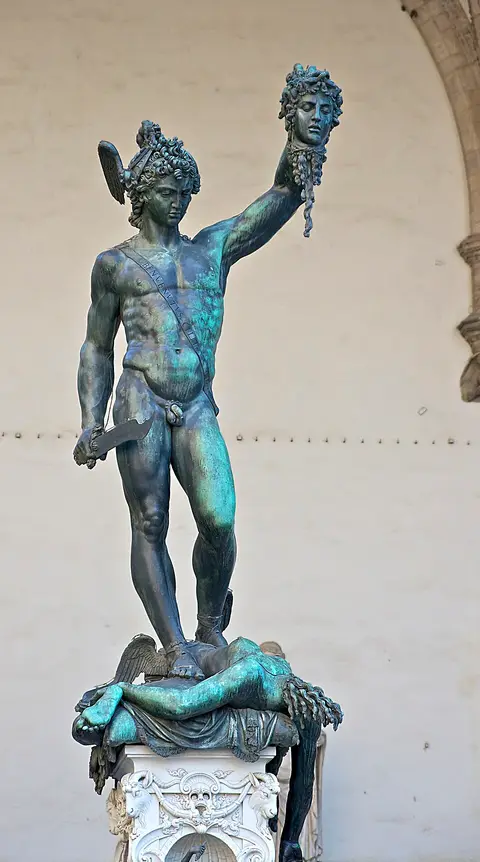
  1. The child of Poseidon and Medusa. When Perseus cuts off Medusa's head, he springs from her neck.
  2. Hesiod links his name to his birth by the springs (pēgai) of Oceanus. He flies up to Olympus and carries Zeus's thunder and lightning.
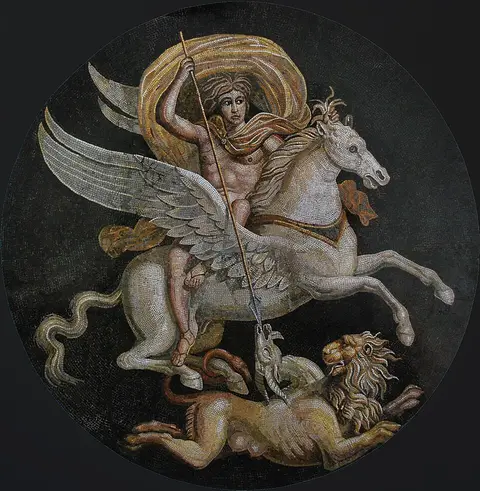
  3. Bellerophon tames him with Athena's golden bridle and defeats the Chimera from his back.

Family

Parents

Hesiod, Theogony 278–286

Siblings

½ Half-sibling: only one parent in common.

To see the whole family, open the Pegasus family tree → · how is Pegasus related to Zeus? → · compare with someone else →

The spring of the Muses

Hippocrene, the 'horse spring' on Mount Helicon, gushed out where Pegasus struck the ground with his hoof. The spring was sacred to the Muses, so in later centuries Pegasus became a symbol of poetic inspiration.

Pausanias, Description of Greece 9.31.3; Ovid, Metamorphoses 5.256–264

Pegasus in art

16works depicting Pegasus, in date order, from ancient vases to paintings of the Renaissance and after. All are in the public domain or openly licensed. Click an image for the full-size version and licence details. For scene-by-scene readings of famous vases, see Greek vase painting.

Plaque depicting Pegasus
Plaque depicting Pegasus455 BCDepartment of Greek, Etruscan, and Roman Antiquities of the LouvreCC0 · Photo: Shonagon
Hydria depicting Pegasus
Hydria depicting Pegasus424 BCBnF MuseumCC0 · Photo: Shonagon
Pegasos (sculpture), Corinth, Achilles Vassiliou
Pegasos (sculpture), CorinthAchilles VassiliouCC BY-SA 4.0 · Photo: Katvle
Terracotta bail-amphora (jar)
Terracotta bail-amphora (jar)Metropolitan Museum of ArtCC0 · Photo: Creator:Ixion Painter
Terracotta Panathenaic prize amphora
Terracotta Panathenaic prize amphoraMetropolitan Museum of ArtCC0 · Photo: Kleophrades Painter
Terracotta kylix (drinking cup)
Terracotta kylix (drinking cup)Metropolitan Museum of ArtCC0 · Photo: Psiax
Gilt silver kylix
Gilt silver kylixMetropolitan Museum of ArtCC0
Archaeological artefact depicting Pegasus
Archaeological artefact depicting Pegasus1 BCMusée Saint-RaymondCC BY-SA 4.0 · Photo: Hervé Deschamps-Dargassies
Parnassus, Andrea Mantegna
ParnassusAndrea Mantegna · 1500Department of Paintings of the LouvrePublic domain
Fame, Pieter van Aelst
FamePieter van Aelst · 1520Museo de Tapices del Palacio de la Granja de San Ildefonso, Patrimonio NacionalCC BY-SA 4.0 · Photo: PMRMaeyaert
Pegasus and the Muses, Girolamo Romanino
Pegasus and the MusesGirolamo Romanino · 1540National GalleryPublic domain
Celestial globe with clockwork, Gerhard Emmoser
Celestial globe with clockworkGerhard Emmoser · 1579Metropolitan Museum of ArtCC0
Painting depicting Pegasus, Carlo Saraceni
Painting depicting PegasusCarlo Saraceni · 1599Musée des Beaux-Arts de DijonPublic domain
Perseus and Andromeda, Joachim Wtewael
Perseus and AndromedaJoachim Wtewael · 1611Department of Paintings of the LouvrePublic domain
Painting depicting Pegasus, Peter Candid
Painting depicting PegasusPeter Candid · 1614Bavarian State Painting CollectionsPublic domain
Perseus Freeing Andromeda, Peter Paul Rubens
Perseus Freeing AndromedaPeter Paul Rubens · 1621Gemäldegalerie BerlinPublic domain

Stories featuring Pegasus
Quick questions

Who are Pegasus' parents?
In the main account, Pegasus' father is Poseidon and mother is Medusa. Hesiod, Theogony 278–286
What are Pegasus' symbols?
Wings.
Which myths is Pegasus in?
Perseus and Medusa · Bellerophon and the Chimera.

Ancient sources

This page is based on the texts below. Numbers refer to books and lines.

  • Hesiod, Theogony 278–286
  • Pindar, Olympian 13.63–92
  • Ovid, Metamorphoses 5.256–264