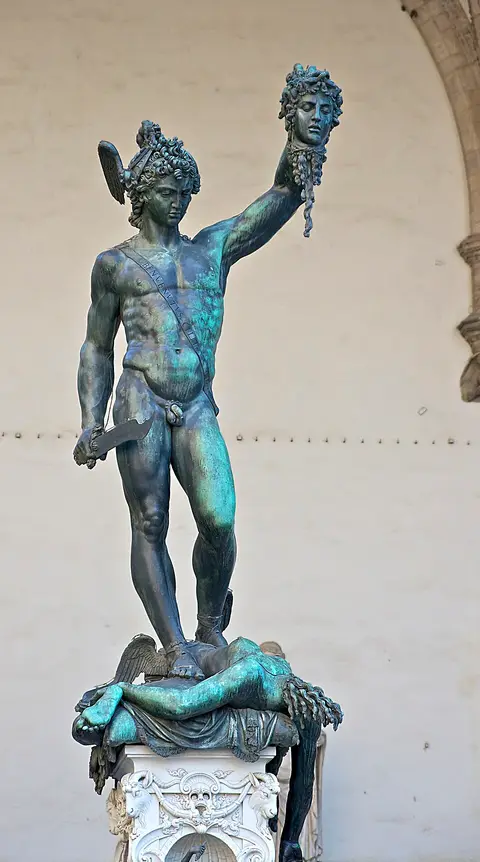
The only mortal of the three Gorgons. Her hair is snakes and anyone who looks at her face turns to stone. Perseus cuts off her head, which ends up on Athena's shield.
In brief
- A daughter of the sea gods Phorcys and Ceto. Of the three Gorgon sisters Stheno and Euryale are immortal, Medusa mortal.
- In Hesiod she lies with Poseidon. When Perseus beheads her, the winged horse Pegasus and the giant Chrysaor spring from her neck.
- The severed head keeps its power to petrify. Perseus uses it against his enemies, then gives it to Athena.
Family
Parents
Hesiod, Theogony 270–276
Consorts and partners
Children
Siblings
½ Half-sibling: only one parent in common.
To see the whole family, open the Medusa family tree → · how is Medusa related to Zeus? → · compare with someone else →
Ovid's Medusa
Ovid tells how Medusa was once a beautiful girl famous for her hair. Poseidon assaults her in Athena's temple, and the outraged goddess turns Medusa's hair into snakes. Apollodorus reports another punishment story: some say Medusa wanted to rival Athena in beauty. In older sources such as Hesiod, she is a Gorgon from birth.
Ovid, Metamorphoses 4.794–803; Apollodorus, Library 2.4.3; Hesiod, Theogony 274–283The face that wards off evil
The Gorgon's head (gorgoneion) was used in antiquity like an evil-eye charm, carved on shields, armour, temple pediments and tombs to keep harm away. Turkey has two famous examples: a huge Medusa head from the frieze of the Temple of Apollo at Didyma now lies in front of the temple, and in Istanbul's Basilica Cistern two Medusa heads, one sideways and one upside down, serve as column bases.
Frieze of the Temple of Apollo at Didyma (2nd century AD); Basilica Cistern (6th century AD)Medusa on Greek vases
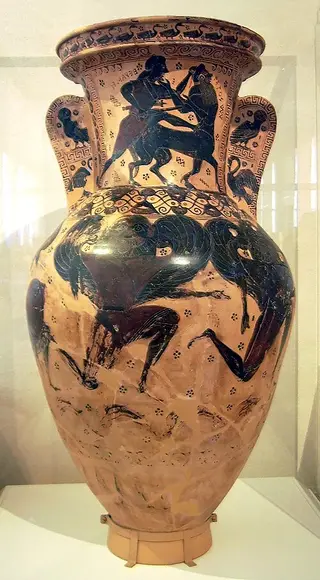
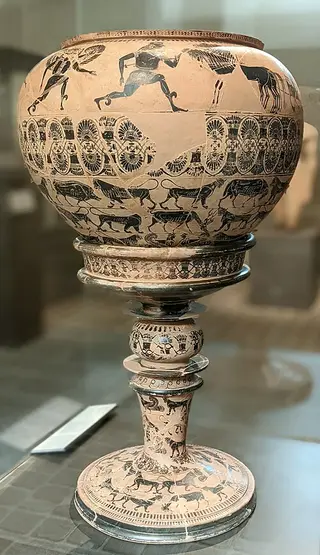
Medusa in art
16works depicting Medusa, in date order, from ancient vases to paintings of the Renaissance and after. All are in the public domain or openly licensed. Click an image for the full-size version and licence details. For scene-by-scene readings of famous vases, see Greek vase painting.


Stories featuring Medusa
Quick questions
- Why does Medusa have snakes for hair?
- In the older sources, such as Hesiod, Medusa is simply born a Gorgon. Ovid tells a later story: she was a young woman famous for her beautiful hair until Poseidon assaulted her in a temple of Athena, and the angry goddess turned her hair into snakes. Apollodorus records another version, in which she is punished for wanting to rival Athena in beauty. Hesiod, Theogony 274–283; Ovid, Metamorphoses 4.794–803; Apollodorus, Library 2.4.3
- Who killed Medusa?
- The hero Perseus. To avoid meeting her gaze he looked at her reflection in a bronze shield as he cut off her head. The winged horse Pegasus sprang from her neck. The head kept its power to turn people to stone; Perseus used it against his enemies and then gave it to Athena. Perseus and Medusa → Hesiod, Theogony 278–283; Apollodorus, Library 2.4.2–2.4.3
- Who are Medusa's parents?
- In the main account, Medusa's father is Phorcys and mother is Ceto. Hesiod, Theogony 270–276
- Who were Medusa's consorts and lovers?
- The partners named in the sources: Poseidon.
- Who are Medusa's children?
- This atlas records 2 children of Medusa: Pegasus and Chrysaor. See the family tree →
- What are Medusa's symbols?
- Snakes for hair, Petrifying gaze.
- Which myths is Medusa in?
- Perseus and Medusa.
Ancient sources
This page is based on the texts below. Numbers refer to books and lines.
- Hesiod, Theogony 270–283
- Apollodorus, Library 2.4.2–2.4.3
- Ovid, Metamorphoses 4.604–803