Three winged sisters with snakes for hair whose gaze turns people to stone. Two are immortal; the third, Medusa, is killed by Perseus.
In brief
- Hesiod says they live beyond famous Oceanus, at the edge of night, near the Hesperides.
- Apollodorus describes them with heads wreathed in dragon scales, tusks like a boar's, hands of bronze and golden wings. Anyone who looks at them turns to stone.
- Stheno ('strong') and Euryale ('wide-roaming') are immortal. When Perseus cuts off Medusa's head the two sisters chase him, but he escapes, invisible in the helmet of Hades.
Family
Parents
Hesiod, Theogony 274–276
Siblings
½ Half-sibling: only one parent in common.
To see the whole family, open the Gorgons family tree → · how is Gorgons related to Zeus? → · compare with someone else →
The birth of the flute
Pindar says that when Perseus killed Medusa, Athena heard the wailing of Euryale and her snake-haired sisters. To imitate it she invented the aulos, the double flute, and called the tune the 'many-headed melody'. This is the same flute Athena later threw away and the satyr Marsyas picked up.
Pindar, Pythian 12.6–27A face against the evil eye
The Gorgon's head, the gorgoneion, was carved on shields, armour, temples and coins to keep evil away; there is one at the centre of Athena's aegis. The giant Medusa head from the Temple of Apollo at Didyma and the Medusa heads at the bases of two columns in Istanbul's Basilica Cistern are famous Anatolian examples of this tradition.
Homer, Iliad 5.738–742, 11.36–37Gorgons on Greek vases
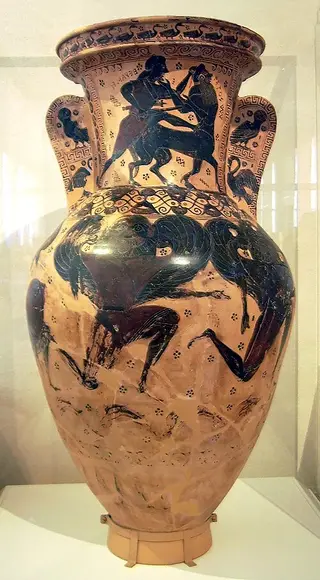
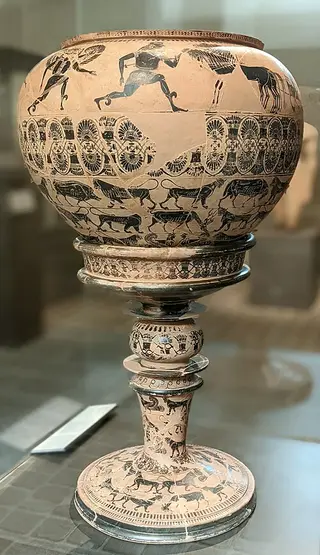
Quick questions
- What are the names of the three Gorgons?
- Stheno, Euryale and Medusa, daughters of the sea gods Phorcys and Ceto. Only Medusa was mortal. Apollodorus describes them with heads wreathed in dragon scales, tusks like boars, bronze hands and golden wings; anyone who looked at them turned to stone. When Perseus beheaded Medusa, her sisters chased him, but he escaped wearing the cap of invisibility. Perseus and Medusa → Hesiod, Theogony 274–283; Apollodorus, Library 2.4.2–2.4.3
- Who are Gorgons' parents?
- In the main account, Gorgons' father is Phorcys and mother is Ceto. Hesiod, Theogony 274–276
- What are Gorgons' symbols?
- Snake hair, Petrifying gaze, Gorgoneion.
Ancient sources
This page is based on the texts below. Numbers refer to books and lines.
- Hesiod, Theogony 270–283
- Apollodorus, Library 2.4.2–2.4.3
- Hesiod, Shield of Heracles 229–237
- Pindar, Pythian 12