Young Theseus travels by land from Troezen to Athens to find his father. The road along the Saronic Gulf is full of bandits who terrorise travellers. Theseus punishes each of them with his own method. Tap a stop, or move through them with the arrow keys.
Coastlines: Natural Earth (public domain), coarse resolution. Places are where the ancient writers put them; the exact site of Erineus is unknown.
Stop 1 · Argolis
Troezen
Today: Trizina (Greece)
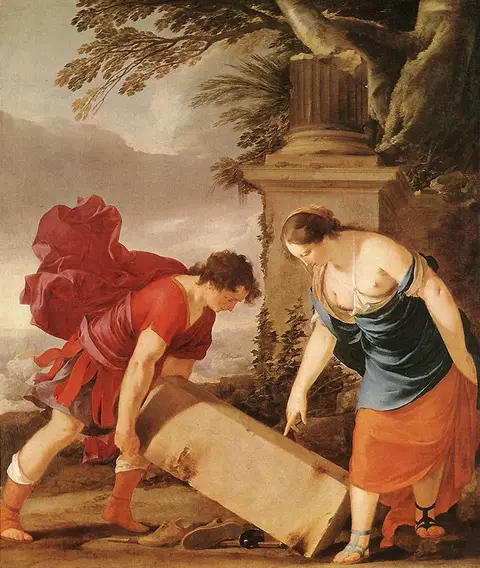
Aegeus, king of Athens, hides his sword and sandals under a great rock. When Theseus is sixteen he lifts the rock and sets out to find his father.
The sea route is safer, but Theseus chooses the road by land. Plutarch says he wanted to win fame like Heracles.
Plutarch, Theseus 6–7; Pausanias, Description of Greece 2.32.7
Where was it? At Troezen Pausanias saw a stone called 'the rock of Theseus'.
On the Isthmus Sinis is known as 'Pityocamptes', the Pine-bender. He ties travellers to two bent pine trees, then lets the trees go and tears them apart.
On the steep cliffs near Megara, Sciron makes travellers wash his feet. As they bend down he kicks them into the sea, where a giant turtle waits below.
Theseus throws him off his own cliff. Pausanias says the narrow road over the cliffs is named after Sciron.
At the last stop before Athens lives Procrustes. Apollodorus also calls him Damastes or Polypemon. He lays short guests on a long bed and hammers them out to fit, and lays tall guests on a short bed and cuts off what hangs over.
Theseus does the same to him. The phrase 'a Procrustean bed' comes from this story.
Where was it? According to Pausanias, a place called Erineus on the banks of the Cephissus at Eleusis; Plutarch also names Erineus. The exact spot is unknown.
Aegeus does not recognise his son. Medea, who lives in the palace, convinces him that the stranger is dangerous. First they send Theseus against the bull of Marathon. Theseus binds the bull and brings it back.
At a feast he is offered a cup of poison. When Theseus draws his sword to cut the meat, Aegeus recognises the sword and knocks the cup from his hand. Medea flees Athens.