Daughter of Pittheus, king of Troezen, and mother of Theseus. She raises her son in Troezen and sends him to Athens with the tokens his father left. In old age she is taken to Troy as Helen's servant; when the city falls her grandsons set her free.
In brief
- Aegeus, king of Athens, stops at Troezen on his way back from Delphi. Pittheus understands the oracle that Aegeus could not, and puts him to bed with his daughter Aethra. That same night Poseidon also lies with Aethra.
- Before leaving, Aegeus places his sword and sandals under a rock. When his son is strong enough to lift the rock, he is to take them and come to Athens.
- According to Plutarch, when Theseus has grown up Aethra takes him to the rock and tells him who his father is.
Family
Parents
Apollodorus, Library 3.15.7; Plutarch, Theseus 3
To see the whole family, open the Aethra family tree → · how is Aethra related to Zeus? → · compare with someone else →
The island of Sphaeria
Pausanias reports a local story from Troezen. In a dream Aethra receives an order from Athena and crosses to the small island of Sphaeria near the shore, to make offerings at the tomb of Sphaerus, Pelops's charioteer. Poseidon lies with her on the island.
Afterwards Aethra renames the island Hiera, 'the Holy Island', and founds a temple there to Athena Apaturia, 'Athena the Deceiver'. In Pausanias's day the girls of Troezen dedicated their girdles to this temple before marriage.
Pausanias, Description of Greece 2.33.1Captivity and Troy
Theseus and Pirithous carry off the young Helen and leave her with Aethra at Aphidna in Attica. Helen's brothers, the Dioscuri, take Aphidna, rescue Helen and lead Aethra away to Sparta as a captive.
Aethra is now Helen's servant. In the Iliad, when Helen goes up onto the walls, one of the two women with her is 'Aethra, daughter of Pittheus'.
When Troy falls, Theseus's sons Demophon and Acamas find their grandmother. With Agamemnon's consent they take her with them. Pausanias describes seeing Aethra, her head shaved, in Polygnotus's painting at Delphi.
Apollodorus, Library 3.10.7; Apollodorus, Epitome 1.23, 5.22; Homer, Iliad 3.143–144; Plutarch, Theseus 32, 34; Pausanias, Description of Greece 10.25.7Euripides' Suppliants
Euripides' play 'The Suppliants' opens at Eleusis, at the altar of Demeter and Kore. As Aethra makes a sacrifice there, the mothers of the Seven who died before Thebes surround her and beg for help in burying their sons.
At first Theseus does not want to help. Aethra persuades him: the law of the gods demands that the dead be buried. In the end Theseus goes to recover the bodies from Thebes.
Euripides, Suppliants 1–41, 286–364Aethra in art
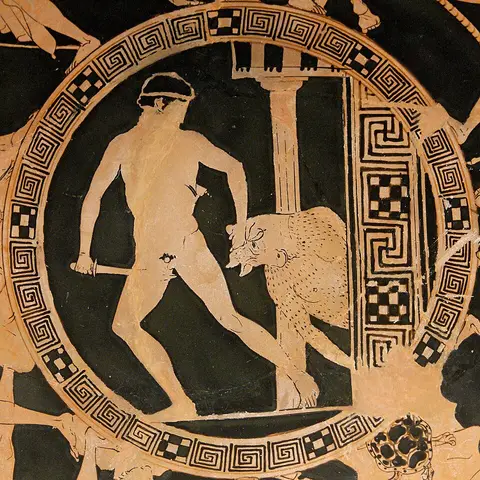
1work depicting Aethra, in date order, from ancient vases to paintings of the Renaissance and after. All are in the public domain or openly licensed. Click an image for the full-size version and licence details. For scene-by-scene readings of famous vases, see Greek vase painting.

Stories featuring Aethra
Quick questions
- Who are Aethra's parents?
- In the main account, Aethra's father is Pittheus. The mother is not named in this account. Apollodorus, Library 3.15.7; Plutarch, Theseus 3
- Who were Aethra's consorts and lovers?
- The partners named in the sources: Aegeus and Poseidon.
- Who are Aethra's children?
- This atlas records 1 child of Aethra: Theseus. See the family tree →
- What are Aethra's symbols?
- Sword and sandals.
- Which myths is Aethra in?
- Theseus' road to Athens: six bandits.
Ancient sources
This page is based on the texts below. Numbers refer to books and lines.
- Apollodorus, Library 3.15.7, 3.10.7
- Apollodorus, Epitome 1.23, 5.22
- Plutarch, Theseus 3–6, 32, 34
- Homer, Iliad 3.143–144
- Pausanias, Description of Greece 2.33.1, 10.25.7
- Euripides, Suppliants