Theseus' road to Athens: six bandits
The young Theseus travels overland from Troezen to Athens to find his father. Along the way he punishes the bandits who terrorise travellers with their own methods. The expression 'Procrustean bed' comes from this journey.
In this story
-
The sword under the rock
Aegeus, king of Athens, spends a night with Princess Aethra in Troezen. As he leaves he hides his sword and sandals under a great rock, and tells Aethra that when the child grows up and can lift the rock, he should take them and come to Athens.
At sixteen Theseus lifts the rock. The sea route is safer, but he chooses the road by land. Plutarch says his model is Heracles, and he wants to win fame like him.
Plutarch, Theseus 6–7; Pausanias, Description of Greece 1.27.8 -
The club-man and the pine-bender
At Epidaurus, Periphetes kills travellers with an iron club. Theseus defeats him and takes the club, which from then on becomes his emblem.
At the Isthmus of Corinth lives Sinis, called Pityocamptes, 'pine-bender'. He ties travellers to two bent pine trees and lets the trees go, tearing them in two. Theseus kills him the same way.
At Crommyon the villagers live in terror of a huge wild sow. Theseus kills her too.
Apollodorus, Epitome 1.1–1.2; Plutarch, Theseus 8–9 -
The cliffs and the wrestler
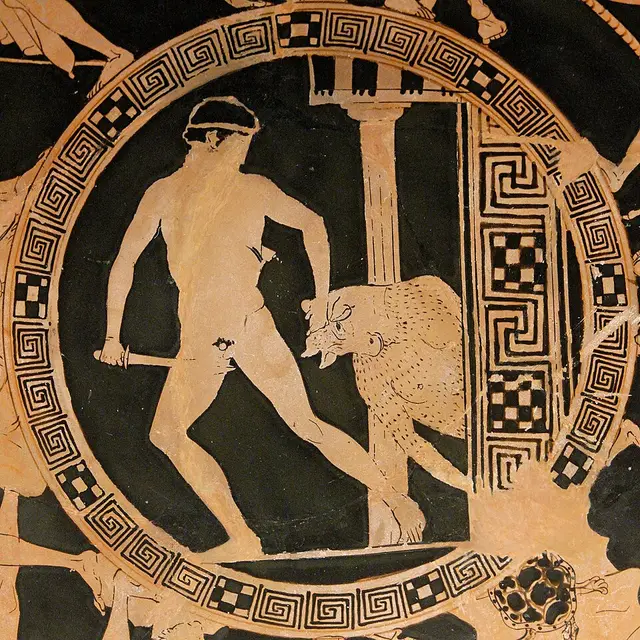
On the steep cliffs near Megara, Sciron makes travellers wash his feet. As they bend down he kicks them into the sea, where a giant turtle is waiting. Theseus throws him off his own cliff.
At Eleusis, Cercyon forces travellers to wrestle with him and kills them. Theseus lifts him into the air and dashes him to the ground.
Apollodorus, Epitome 1.2–1.3; Plutarch, Theseus 10–11 -
The bed of Procrustes
At the last stop before Athens lives Procrustes, whom Apollodorus also calls Damastes or Polypemon. In his house by the road he has two beds, one short and one long. He lays short guests on the long bed and hammers them out to fit it; tall ones he lays on the short bed and cuts off whatever sticks out.
Theseus does the same to him. The expression 'Procrustean bed' describes forcing everything into a single mould.
Apollodorus, Epitome 1.4; Plutarch, Theseus 11; Diodorus 4.59 -
A cup of poison in Athens
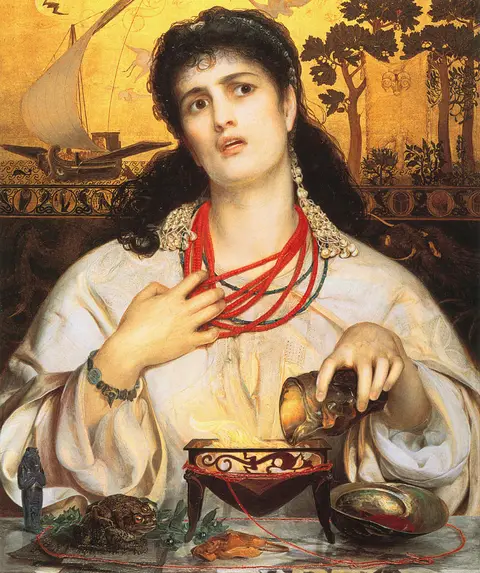
When Theseus reaches Athens, Aegeus does not recognise him. But Medea, who lives at the palace, guesses who he is and persuades Aegeus that the stranger is dangerous. First they send him against the bull of Marathon; Theseus ties it up and brings it back.
Then at a feast Theseus is offered a cup of poison. He draws his sword to cut the meat. Aegeus recognises the sword and knocks the cup from his hand. Medea flees Athens, and Theseus becomes heir to his father's throne.
Apollodorus, Epitome 1.5–1.6; Plutarch, Theseus 12
This story on Greek vases
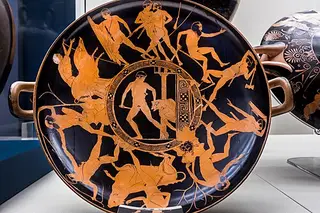
What each painter chose to show, scene by scene: Greek vase painting →
Ancient sources
- Apollodorus, Epitome 1.1–1.6
- Plutarch, Theseus 6–14
- Bacchylides 18
- Ovid, Metamorphoses 7.404–452
- Diodorus 4.59