Jason and the heroes of the Argo sail to the eastern edge of the known world, to Colchis, for the Golden Fleece. Most of the route runs along the coasts of today’s Turkey: the Dardanelles and the Bosphorus, the Sea of Marmara and the Black Sea. The stops follow the Argonautica of Apollonius of Rhodes. Tap a stop, or move through them with the arrow keys.
Coastlines: Natural Earth (public domain). Places are ancient and traditional identifications.
Stop 1 · The harbour of Pagasae
Iolcus
Today: Near Volos (Greece)
Pelias, king of Iolcus, sends Jason to fetch the Golden Fleece from Colchis. The craftsman Argus builds the Argo with Athena’s help.
The heroes gather at the harbour of Pagasae and choose Jason as their leader. The ship sails out to sea past the foot of Mount Pelion.
Apollonius of Rhodes, Argonautica 1.317–608; Apollodorus, Library 1.9.16
Where was it? Pagasae lies on the shore of the Gulf of Volos; the place is known.
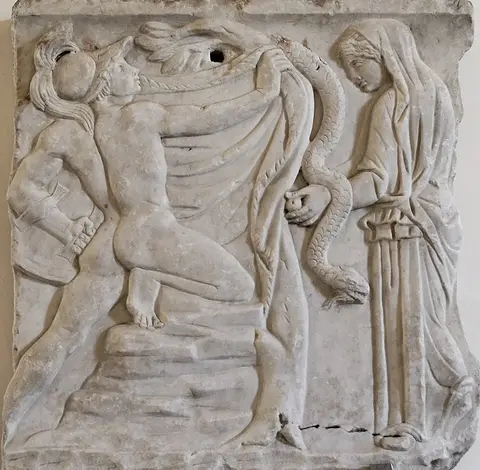
A year earlier the women of Lemnos killed every man on the island. Only Queen Hypsipyle saved her father Thoas, by setting him adrift in a chest.
The women welcome the Argonauts, and the heroes stay a long time. Jason has a son by Hypsipyle, Euneus. In the end Heracles angrily calls them back to the ship.
After passing through the Dardanelles, the Argo reaches the land of the Doliones on the Sea of Marmara. The young king Cyzicus welcomes them as friends. Six-armed giants from the mountain attack the harbour, and Heracles shoots them down.
The night they leave, a contrary wind drives them back. In the dark neither side recognises the other, and they fight. Jason unknowingly kills the king who had been his host. The king’s young wife Cleite cannot bear her grief and takes her own life.
Apollonius of Rhodes, Argonautica 1.936–1152; Apollodorus, Library 1.9.18
Where was it? The ruins of Cyzicus lie at the neck of the Kapıdağ peninsula.
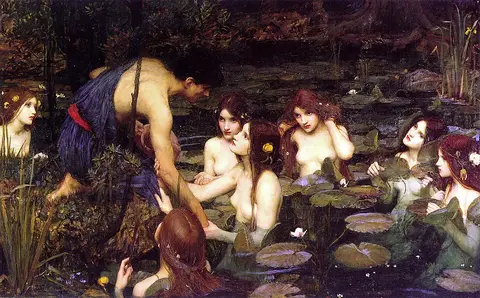
At Cius, Heracles goes into the woods to find a tree for a new oar. His young companion Hylas goes to fetch water. The nymph of the spring falls in love with Hylas and draws him down into the water.
Heracles plunges into the forest to search for him. The Argo sails on without him, and so Heracles takes no part in the rest of the voyage.
Apollonius of Rhodes, Argonautica 1.1153–1357; Apollodorus, Library 1.9.19
Where was it? The city of Cius stood where Gemlik is today.
Today: The Asian shore south of the Bosphorus (Turkey)
Amycus, king of the Bebryces, forces every stranger who comes to his land to box with him. Polydeuces of the Argonauts accepts the challenge.
The quick Polydeuces defeats and kills the giant Amycus. A battle between the Bebryces and the Argonauts follows.
Apollonius of Rhodes, Argonautica 2.1–163; Apollodorus, Library 1.9.20
Where was it? Apollonius places the Bebryces on the Bithynian coast before the Bosphorus. Pliny (5.150) mentions a “harbour of Amycus” on this coast; it is sought today on the Asian side of the Bosphorus, around Beykoz.
Today: The Black Sea mouth of the Bosphorus (Turkey)
On the Thracian shore of the Bosphorus lives the blind seer Phineus. Zeus has punished him for revealing the future too plainly to mortals. Every day the Harpies snatch and foul his food. Zetes and Calais, sons of the North Wind, chase the Harpies away.
In return Phineus tells them how to pass the Clashing Rocks at the mouth of the Black Sea. First they let a dove fly through; it loses only its tail feathers. With a push from Athena the Argo gets through too, losing only the ornament on its stern. From that day on the rocks stand still.
Apollonius of Rhodes, Argonautica 2.178–647; Apollodorus, Library 1.9.21–1.9.22
Where was it? Herodotus (4.85) says the Persian king Darius went to the Cyanean rocks at the Black Sea mouth of the Bosphorus, and that the Greeks said these rocks once moved.
Lycus, king of the Mariandyni, welcomes the Argonauts gladly. He rejoices that they killed Amycus, for the Bebryces are his enemies too.
This is a sad stop. The seer Idmon is killed by a wild boar, and Tiphys, the ship’s helmsman, falls ill and dies. Ancaeus takes the helm. Nearby, on the Acherusian headland, there was believed to be a cave leading down to the underworld.
Apollonius of Rhodes, Argonautica 2.720–910
Where was it? Xenophon (Anabasis 6.2.2) names the Acherusian peninsula near Heraclea as the place where Heracles went down to fetch Cerberus.
Here Apollonius tells of Sinope, who gave the city its name. Zeus had promised to grant her any wish. She asked to remain unmarried, binding Zeus by his own word. She tricked Apollo and the river Halys in the same way.
At Sinope three brothers who had once travelled with Heracles, Deileon, Autolycus and Phlogius, join the Argonauts.
Apollonius of Rhodes, Argonautica 2.946–961
Where was it? The city has kept its name to this day.
The Argo comes to the mouth of the Thermodon, where the warrior women, the Amazons, live.
According to Apollonius, had the Argonauts landed they would have fought the Amazons. But a north wind sent by Zeus carries them away from the shore, and there is no battle.
Apollonius of Rhodes, Argonautica 2.962–1000
Where was it? Ancient writers place Themiscyra, the city of the Amazons, on the plain of the Thermodon.
The island is home to the birds of Ares, which shoot their feathers like arrows. On Phineus’s advice the Argonauts put on their helmets and beat their shields to make a din, and the birds flee in fear.
On the island they find four shipwrecked young men. They are the sons of Phrixus, and they guide the Argonauts on to Colchis.
Apollonius of Rhodes, Argonautica 2.1030–1230
Where was it? Apollonius does not give its exact place; today it is usually identified with Giresun Island.
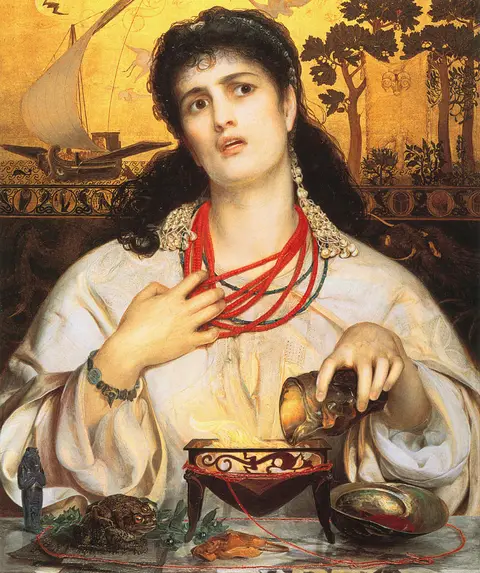
The Argo enters the river Phasis and reaches the land of King Aeetes. To give up the fleece, Aeetes sets Jason two tasks: he must yoke the fire-breathing, bronze-footed bulls, plough the field and sow it with a dragon’s teeth.
Hera and Athena ask Aphrodite for help. Aphrodite’s son Eros shoots an arrow that makes Aeetes’ daughter Medea fall in love with Jason.
Apollonius of Rhodes, Argonautica 2.1260–1285, 3; Apollodorus, Library 1.9.23
Today: Traditionally the area of Kutaisi (Georgia)
Medea gives Jason an ointment that protects him from fire. She tells him to throw a stone among the armed men who spring up from the earth. The warriors turn on one another, and Jason completes the tasks.
Even so, Aeetes will not give up the fleece. In the grove of Ares, Medea lulls to sleep the sleepless dragon that guards it. Jason takes the fleece, and the two of them flee on the Argo.
Apollonius of Rhodes, Argonautica 3.1–4.211; Apollodorus, Library 1.9.23
Where was it? Ancient writers place the city of Aea on the river Phasis; its modern site is uncertain.
On the outward route the ancient writers largely agree. On the way home each brings the Argo back by a different road, so the return is not drawn on the map.
Apollonius of Rhodes
The Argo enters the Danube (Ister), comes out into the Adriatic, and goes down the Eridanus and the Rhodanus to the Tyrrhenian Sea. It calls at Circe’s island, passes the Sirens and reaches the land of the Phaeacians. A storm throws it onto the shoals of Libya, and the heroes carry the ship on their shoulders. Off Crete they overcome the bronze giant Talos with Medea’s magic.
Apollonius of Rhodes, Argonautica 4
Pindar
The Argonauts pass through Ocean and the Red Sea, and carry the ship for twelve days across the Libyan desert.
Pindar, Pythian Odes 4.25–27, 251–254
Apollodorus
Medea kills her young brother Apsyrtus, whom she had brought on board, and throws the pieces into the sea. While Aeetes gathers them, the Argo escapes. On the way home they call at Circe’s island, pass the Sirens, and visit the Phaeacians and Crete.