God of fire, metalworking and craft. Born lame, he is thrown from Olympus; he makes the gods' weapons and wondrous objects.
In brief
- In Hesiod Hera bears him alone, angry that Zeus has produced Athena by himself. In Homer he is the son of Zeus and Hera.
- In the Odyssey he is the husband of Aphrodite. In the Iliad his wife is Charis; in Hesiod she is Aglaea, the youngest of the Graces.
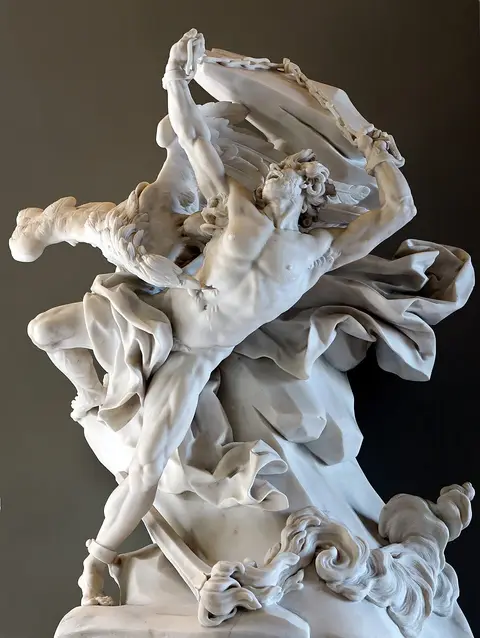
- He makes the shield of Achilles, the aegis of Zeus, Pandora, and the chains that bind Prometheus.
Family
Consorts and partners
Children
To see the whole family, open the Hephaestus family tree → · how is Hephaestus related to Zeus? → · compare with someone else →
Twice thrown from Olympus
In the Iliad Hephaestus recalls two falls. Once, when he tried to protect Hera, Zeus seized him by the foot and hurled him down; he fell all day and landed at sunset on Lemnos. In the other, his mother Hera, ashamed that he was born lame, threw him out herself, and the sea goddesses Thetis and Eurynome hid him in a cave for nine years.
Homer, Iliad 1.590–594, 18.394–405The shield of Achilles
Thetis asks him for new armour for her son. In one night Hephaestus forges it all. Book 18 of the Iliad describes the scenes on the shield at length: cities, weddings, a lawsuit, harvest and dance, one of the first great descriptions of a work of art in literature.
Homer, Iliad 18.468–617Hephaestus on Greek vases
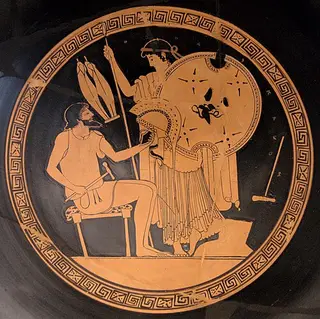
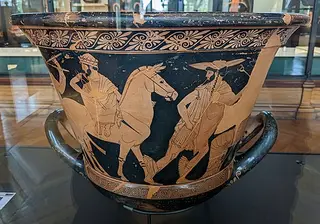
Hephaestus in art
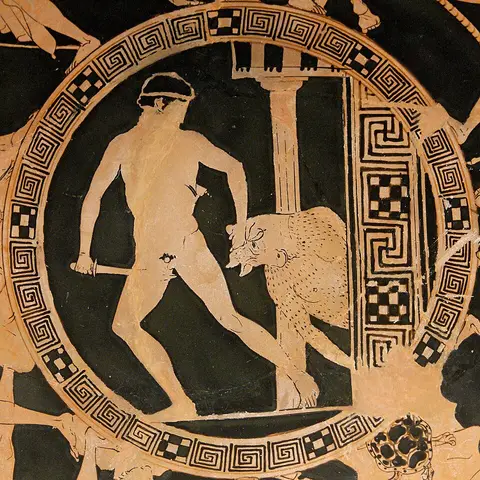
14works depicting Hephaestus, in date order, from ancient vases to paintings of the Renaissance and after. All are in the public domain or openly licensed. Click an image for the full-size version and licence details. For scene-by-scene readings of famous vases, see Greek vase painting.


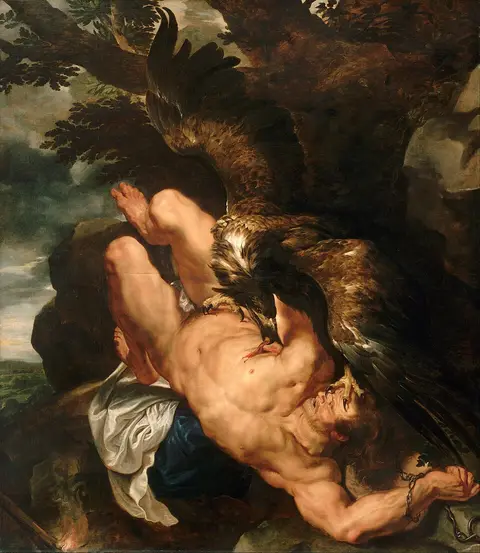
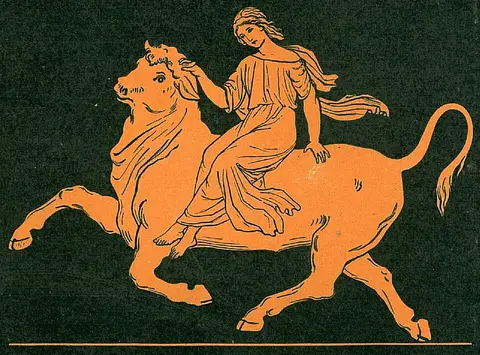
Stories featuring Hephaestus
Quick questions
- Why was Hephaestus thrown from Olympus?
- The Iliad tells of two falls. In one, Zeus seizes him by the foot and hurls him from heaven for taking Hera's side; he falls all day and lands on Lemnos at sunset. In the other, Hera herself throws him out, ashamed that he was born lame, and Thetis and Eurynome hide him in a cave for nine years. Homer, Iliad 1.590–594, 18.394–405
- Who was Hephaestus married to?
- In the Odyssey his wife is Aphrodite. In the Iliad she is Charis, and in Hesiod Aglaea, the youngest of the Graces. Homer, Odyssey 8.266–270; Homer, Iliad 18.382–383; Hesiod, Theogony 945–946
- Who are Hephaestus' parents?
- In the main account, Hephaestus' mother is Hera. The father is not named in this account. Other accounts name other parents; the family box above lists them all with their sources. Hesiod, Theogony 927–929
- Who were Hephaestus' consorts and lovers?
- The partners named in the sources: Aphrodite.
- Who are Hephaestus' children?
- This atlas records 1 child of Hephaestus: Periphetes. See the family tree →
- What is Hephaestus' Roman name?
- In Roman mythology Hephaestus is known as Vulcan. All Greek and Roman names →
- What are Hephaestus' symbols?
- Hammer, Anvil, Tongs.
- Which myths is Hephaestus in?
- Prometheus's fire and Pandora · Cadmus and Europa: the bull, the dragon and the alphabet · Prometheus unbound · Theseus' road to Athens: six bandits.
Ancient sources
This page is based on the texts below. Numbers refer to books and lines.