Cadmus and Europa: the bull, the dragon and the alphabet
Zeus, as a white bull, carries off the Phoenician princess Europa to Crete. Her brother Cadmus sets out to find her and never does, but by following a cow he founds Thebes. The Greeks also honoured him as the man who brought them the alphabet.
In this story
-
The white bull
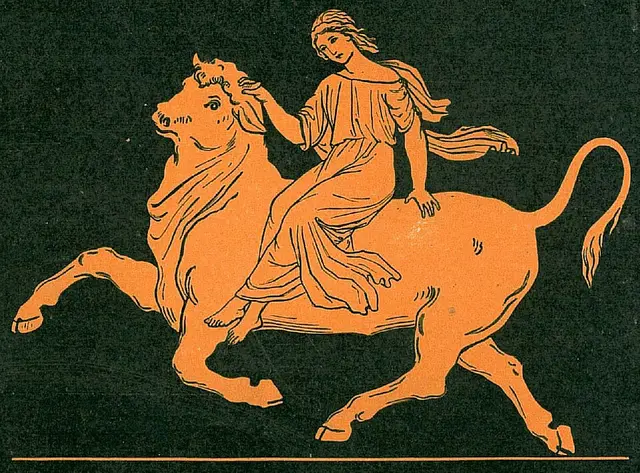
Europa, daughter of Agenor, king of Phoenicia, is gathering flowers on the shore with her friends when Zeus falls in love with her. He turns himself into a gentle white bull and mingles with them. Europa hangs a garland on the bull's neck and climbs onto its back. Suddenly the bull heads out to sea and swims to Crete.
By Zeus, Europa bears Minos, Rhadamanthys and, in Apollodorus, Sarpedon. Later Asterius, king of Crete, marries her and raises her children.
Herodotus doubts that the continent of Europe is named after this Phoenician princess. As he points out, Europa never went to Europe at all; she only went from Phoenicia to Crete, and from there to Lycia.
Apollodorus, Library 3.1.1–3.1.2; Ovid, Metamorphoses 2.833–875; Moschus, Europa; Herodotus 4.45 -
Following the cow
Agenor sends his sons to look for Europa and orders them not to come back without her. None of them finds her, and each settles where he has gone: Phoenix in Phoenicia, Cilix in Cilicia. Cadmus goes to Thrace with his mother Telephassa.
When his mother dies, Cadmus consults the oracle at Delphi. It tells him to stop looking for Europa: he must follow a cow, and found a city where it lies down exhausted. The cow lies down in Boeotia, and there Cadmus founds the Cadmea, the citadel of Thebes.
Apollodorus, Library 3.1.1, 3.4.1; Ovid, Metamorphoses 3.1–25 -
The dragon's teeth
To sacrifice the cow to Athena, Cadmus sends his men to a spring for water. The spring is guarded by a dragon of Ares, which kills most of them. Cadmus kills the dragon with a stone, or a spear.
On Athena's advice he sows the dragon's teeth in the ground. Armed men spring up from the earth. Cadmus throws a stone among them, and not knowing who threw it, they turn on each other. Five survive. These 'sown men', the Spartoi, become the ancestors of the noble families of Thebes.
For killing the dragon of Ares, Cadmus has to serve Ares for eight years.
Apollodorus, Library 3.4.1–3.4.2; Ovid, Metamorphoses 3.26–130 -
A wedding the gods attended
When his service is over, Zeus gives him Harmonia, daughter of Ares and Aphrodite, as his wife. All the gods come to the wedding bearing gifts. Cadmus gives Harmonia a robe and a necklace made by Hephaestus, a necklace that will bring disaster on its owners for generations.
Their daughters, Semele, Ino, Agave and Autonoë, all come to a bitter end. Semele is burned up as she gives birth to Dionysus, Agave tears her son Pentheus apart, and Autonoë's son Actaeon is eaten by his own hounds.
Apollodorus, Library 3.4.2–3.4.4; Pindar, Pythian 3.88–95 -
The serpent couple, and the letters
In their old age Cadmus and Harmonia leave Thebes for Illyria, where both are turned into serpents. Zeus sends them to the Isles of the Blessed, Elysium.
Herodotus says the Phoenicians who came with Cadmus taught the Greeks the alphabet, which is why the Greeks called the letters 'Phoenician letters'. This agrees with modern research showing that the Greek alphabet was derived from the Phoenician.
Apollodorus, Library 3.5.4; Ovid, Metamorphoses 4.563–603; Herodotus 5.58
This story on Greek vases
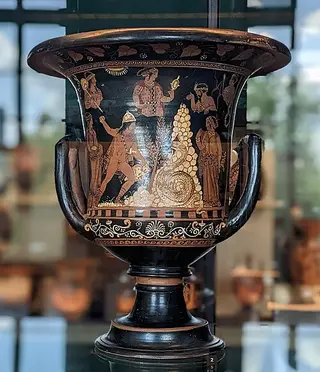 Cadmus and the dragon of Thebes
mid-4th century BC · Louvre, Paris
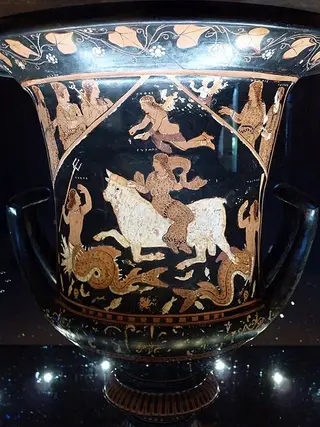 Europa and the bull
mid-4th century BC · National Archaeological Museum of Sannio Caudino, Montesarchio
What each painter chose to show, scene by scene: Greek vase painting →
Ancient sources
- Apollodorus, Library 3.1.1–3.5.4
- Ovid, Metamorphoses 2.833–3.137, 4.563–603
- Moschus, Europa
- Herodotus 4.45, 5.58
- Homer, Iliad 14.321–322