Prometheus's fire and Pandora
The Titan who tricks the gods and brings fire to mankind, his punishment chained to a rock, and Pandora, the first woman, sent as the price of fire.
In this story
-
The division at Mecone
Gods and men met at Mecone to settle how sacrifices should be shared. Prometheus slaughtered an ox. On one side he wrapped the meat and innards in the ox's stomach; on the other he covered the bones with glistening fat. Then he told Zeus to choose. Zeus took the portion with the fat, and was furious when he found the bones underneath. Hesiod says this is why people burn bones for the gods on their altars.
Hesiod, Theogony 535–557 -
Fire in a fennel stalk
In revenge, Zeus withheld fire from mankind. Prometheus went up to heaven, hid fire in a hollow fennel stalk and brought it back to men. When Zeus saw the gleam of fire among people far below, his anger grew.
Hesiod, Theogony 562–569; Hesiod, Works and Days 47–52 -
Pandora: the price of fire
Zeus announced that in exchange for fire he would send mankind 'an evil'. Hephaestus shaped a lovely young woman from earth and water. Athena taught her weaving and dressed her, Aphrodite gave her charm, and Hermes gave her lies and a cunning nature. Because she carried the gifts of all the gods, she was named Pandora. Prometheus had warned his brother Epimetheus never to accept a gift from Zeus, but Epimetheus took Pandora anyway, and understood his mistake only when it was too late. Pandora lifted the lid of the great jar, and diseases and troubles spread through the world. When the lid closed again, only Hope remained inside.
Hesiod, Works and Days 53–105 -
The Titan on the rock
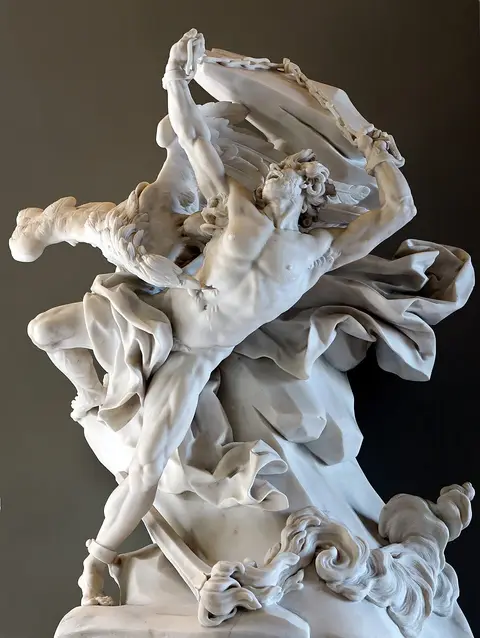
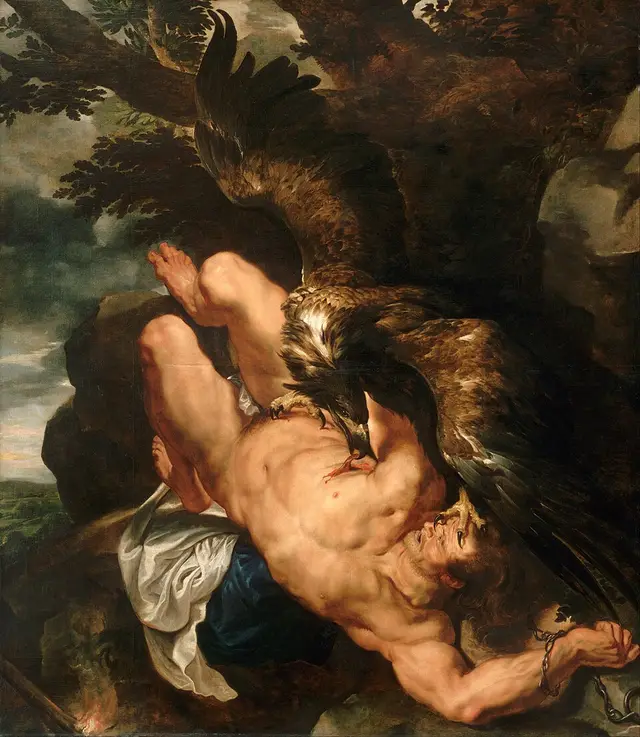
Zeus had Prometheus bound to a rock with unbreakable chains. Every day a long-winged eagle came and ate his immortal liver, and every night the liver grew back as much as the eagle had eaten. In the tragedy attributed to Aeschylus, Prometheus refuses to give in because he knows the secret of a marriage that would bring Zeus down, and he will reveal it only once he is freed.
Hesiod, Theogony 521–525; Aeschylus, Prometheus Bound 907–927 -
Release
Years later Heracles, searching for the apples of the Hesperides, passed by and shot the eagle. Hesiod says Zeus allowed it because he wanted his son's fame to grow. According to Apollodorus the release had a price. The immortal centaur Chiron, wounded by a poisoned arrow, was in unbearable pain, and agreed to die in place of Prometheus, giving up his immortality.
Hesiod, Theogony 526–534; Apollodorus, Library 2.5.4, 2.5.11
Prometheus's fire and Pandora: common questions
Why did Zeus send Pandora?
As the price of fire. After Prometheus stole fire back for mankind, Zeus announced he would send people "an evil" in exchange: Hephaestus shaped Pandora from earth and water, and every god gave her a gift, hence her name, "all-gifted". Pandora →
Hesiod, Works and Days 53–82What was in Pandora's box?
Diseases and troubles: when Pandora lifted the lid they spread through the world, and only Hope stayed inside when the lid closed again. In Hesiod it is a large storage jar (pithos); the "box" comes from Erasmus in 1508. Pandora's box →
Hesiod, Works and Days 90–105; Erasmus, Adagia (1508)What trick did Prometheus play on Zeus?
At Mecone, where gods and men settled how to share sacrifices, he hid the meat of an ox in its stomach and wrapped the bones in glistening fat. Zeus chose the fat and found bones underneath, which, Hesiod says, is why people burn bones for the gods.
Hesiod, Theogony 535–557How was Prometheus freed?
Every day an eagle ate his liver, which grew back each night, until Heracles shot the eagle on his way to the apples of the Hesperides. In Apollodorus the release has a price: the wounded centaur Chiron gives up his immortality in Prometheus's place. Prometheus unbound →
Hesiod, Theogony 521–534; Apollodorus, Library 2.5.4, 2.5.11Ancient sources
- Hesiod, Theogony 507–616
- Hesiod, Works and Days 42–105
- Aeschylus, Prometheus Bound
- Apollodorus, Library 1.7.1–1.7.2