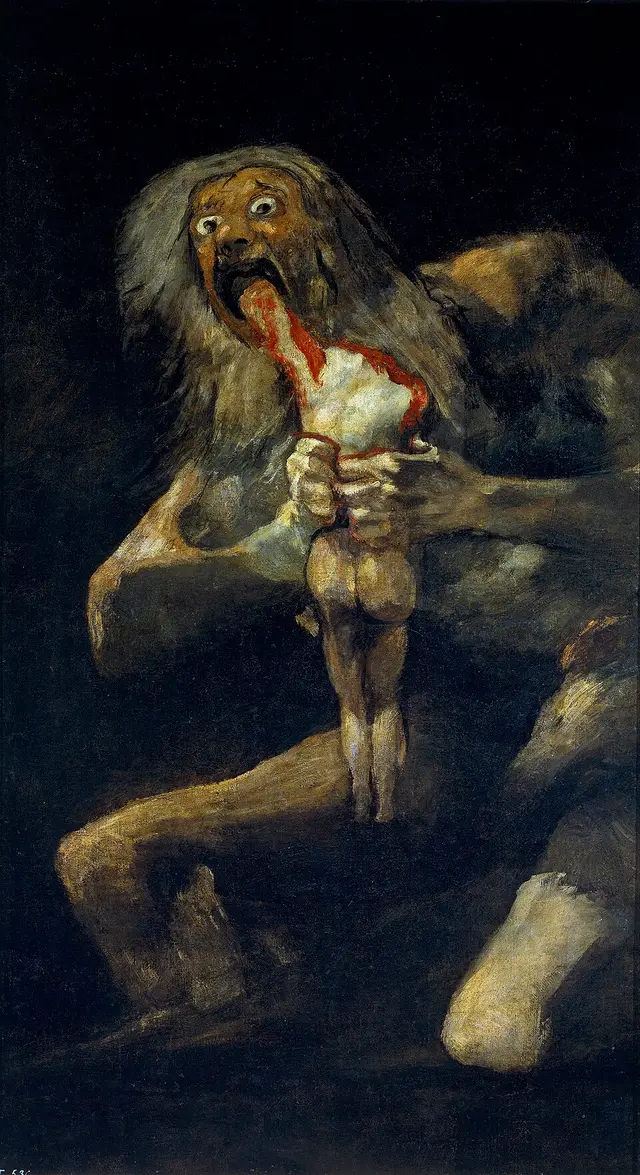
Francisco Goya · Public domain · Wikimedia Commons
In this story
-
In the beginning was Chaos
According to Hesiod, first of all there was Chaos, a vast, yawning void. Then came broad-breasted Gaia, the Earth; Tartarus in the depths below; and Eros, the most beautiful of the gods. From Chaos came dark Erebus and Night. On her own, Gaia gave birth to the starry Sky, Uranus, as great as herself, and then to the mountains and the surging sea, Pontus.
Hesiod, Theogony 116–132 -
The fall of Uranus
Gaia and Uranus had twelve Titans, three one-eyed Cyclopes and three giants with fifty heads and a hundred arms. Uranus hated his children. He would not let them into the light, but pushed them back into the depths of the earth. In her pain Gaia made a great sickle of hard metal and asked her children to take revenge. Only the youngest, Cronus, dared. When Uranus came at nightfall and lay over Gaia, Cronus sprang from his ambush and castrated his father with the sickle. From the blood that fell came the Furies and the Giants; from the foam around the parts that fell into the sea, Aphrodite was born.
Hesiod, Theogony 133–206 -
The father who swallowed his children
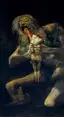
Cronus married his sister Rhea. But Gaia and Uranus had told him he would be overthrown by his own son, so he swallowed each child as soon as it was born: Hestia, Demeter, Hera, Hades and Poseidon. Pregnant with her sixth child, Rhea asked her parents for help, and they sent her to Crete. There Zeus was born and hidden in a cave. Rhea gave Cronus a stone wrapped in swaddling clothes instead of the baby. He swallowed it and suspected nothing.
Hesiod, Theogony 453–491 -
The return of Zeus
Zeus grew up quickly. According to Apollodorus, a drug prepared by Metis made Cronus vomit up first the stone and then all the children he had swallowed. Zeus also freed the Cyclopes his father had imprisoned, and in gratitude they gave him thunder, lightning and the thunderbolt.
Hesiod, Theogony 492–506; Apollodorus, Library 1.2.1 -
The Titanomachy: a ten-year war
The young gods on Olympus and the Titans on Mount Othrys fought for ten years, and neither side could win. On Gaia's advice, Zeus brought up the Hundred-Handers who had been shut beneath the earth and strengthened them with nectar and ambrosia. In the final battle Zeus showed all his might: his thunderbolts set the forests ablaze, and earth and sea boiled. The Hundred-Handers hurled three hundred rocks at a time on the Titans. The defeated Titans were shut in Tartarus, behind gates made by Poseidon, with the Hundred-Handers as their guards. Styx, daughter of Oceanus, won great honour because she and her children fought on Zeus's side.
Hesiod, Theogony 617–735, 383–403 -
The last challenge and the new order
Furious at the Titans' defeat, Gaia joined with Tartarus and bore Typhon, with his hundred serpent heads. Zeus defeated this last and most terrible enemy too with his thunderbolts and cast him into Tartarus. When the war was over, the gods asked Zeus to be their king, and he shared out honours and duties among them. He and his brothers drew lots: Zeus received the sky, Poseidon the sea and Hades the underworld.
Hesiod, Theogony 820–885; Homer, Iliad 15.187–193
Ancient sources
- Hesiod, Theogony 116–885
- Apollodorus, Library 1.1.1–1.2.1