The earth itself and great mother of all the gods. She bears the sky, the mountains and the sea by herself, and is the mother of the Titans.
In brief
- She comes into being right after Chaos. Hesiod calls her 'the ever-sure seat of all'.
- First, alone, she bears Uranus (Sky), the mountains and Pontus (Sea). Then by Uranus she bears the Titans, the Cyclopes and the Hundred-Handers.
- She takes her children's side against both Uranus and Cronus, and her counsel is decisive in Zeus's rise to power.
Family
Parents
Hesiod, Theogony 116–117
Children
* Only in some accounts.
To see the whole family, open the Gaia family tree → · how is Gaia related to Zeus? → · compare with someone else →
The plot against Uranus
Uranus hates some of the children Gaia bears and pushes them back into her body. In pain, Gaia makes a great sickle of hard metal and asks her children to take revenge. Only the youngest Titan, Cronus, dares: he lies in ambush and castrates Uranus.
Hesiod, Theogony 154–182The second plot
When Cronus starts swallowing his children, Rhea consults Gaia and Uranus, who send her to Crete. Zeus is born there in secret and handed to Gaia; Cronus is given a stone in swaddling clothes and swallows it without noticing.
Hesiod, Theogony 468–491Gaia in art
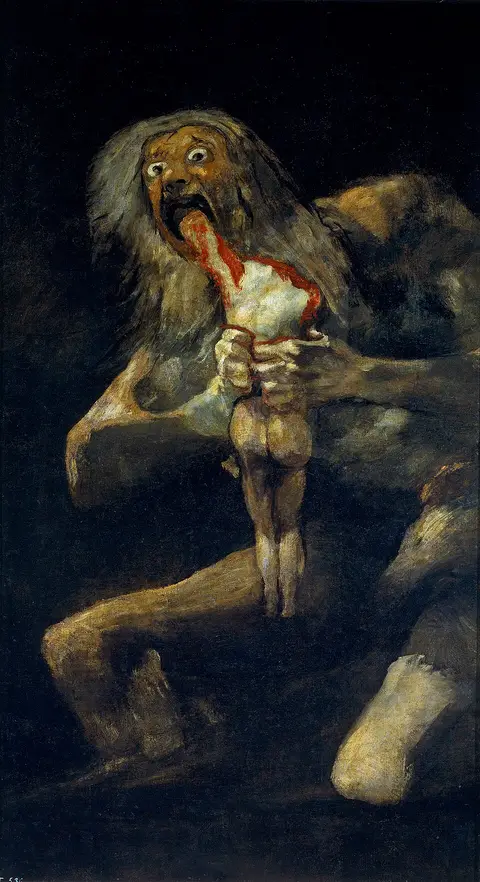
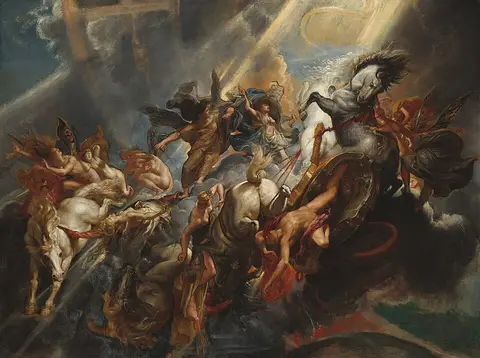
1work depicting Gaia, in date order, from ancient vases to paintings of the Renaissance and after. All are in the public domain or openly licensed. Click an image for the full-size version and licence details. For scene-by-scene readings of famous vases, see Greek vase painting.

Stories featuring Gaia
Quick questions
- Who were Gaia's consorts and lovers?
- The partners named in the sources: Uranus, Pontus and Tartarus.
- Who are Gaia's children?
- This atlas records 27 children of Gaia: Dione, Hecatoncheires, Hyperion, Iapetus, Coeus, Crius, Cronus, Cyclopes, Mnemosyne, Oceanus, Phoebe, Rhea, Tethys and Theia, among others. See the family tree →
- What is Gaia's Roman name?
- In Roman mythology Gaia is known as Terra. All Greek and Roman names →
- Which myths is Gaia in?
- Creation and the war of the Titans · Phaethon and the chariot of the Sun.
Ancient sources
This page is based on the texts below. Numbers refer to books and lines.
- Hesiod, Theogony 116–210, 453–500