Lycaon: the king who became a wolf
Lycaon, king of Arcadia, serves human flesh to his guest to test whether he is really Zeus. Zeus turns him into a wolf. In Ovid, human wickedness like his brings on the great flood.
In this story
-
Testing Zeus
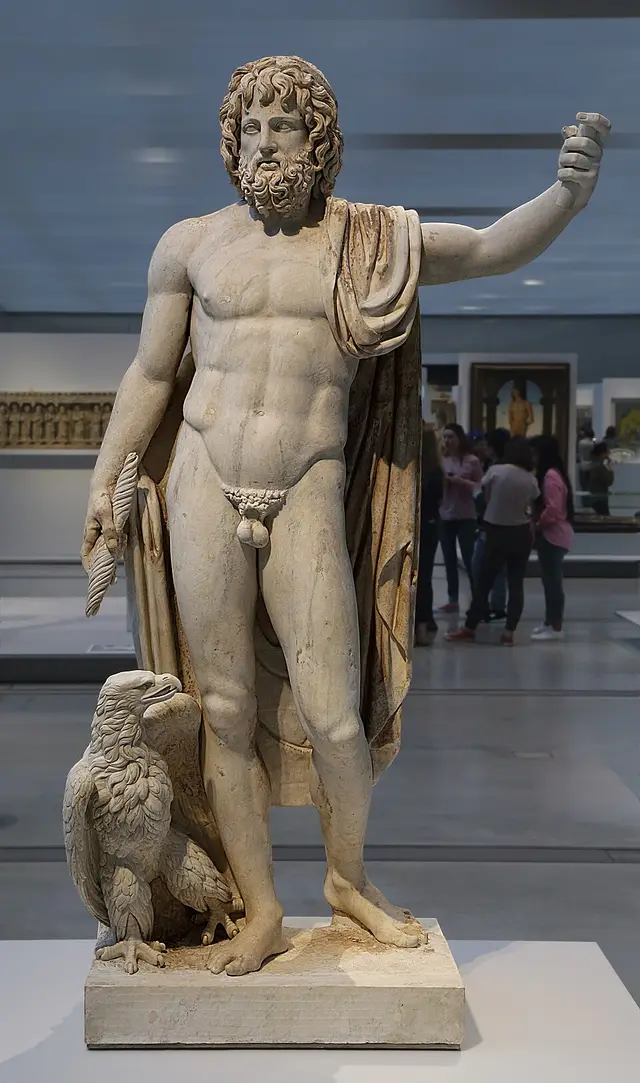
In Ovid, Zeus comes down to earth disguised as a mortal to see human wickedness for himself. In Arcadia he comes to the palace of King Lycaon. When the people begin to pray, Lycaon mocks them and decides to test whether his guest is a god or a mortal.
He kills a hostage, has part of the flesh boiled and part roasted, and serves it at the table. Zeus brings the palace down with his thunderbolt.
Ovid, Metamorphoses 1.163–239 -
The first werewolf
Lycaon flees into the countryside. When he tries to speak, he howls. His clothes turn into fur, his arms into legs. His thirst for blood stays the same, and now he attacks the flocks. His name is linked with lykos, 'wolf'.
In Apollodorus the crime is committed by Lycaon's sons. Zeus kills them with thunderbolts, and only the youngest, Nyctimus, survives, because Earth (Gaia) intervenes. Deucalion's flood comes in the time of Nyctimus.
Ovid, Metamorphoses 1.232–243; Apollodorus, Library 3.8.1–3.8.2 -
Mount Lycaeus
Pausanias describes secret sacrifices to Zeus Lycaeus on Mount Lycaeus in Arcadia. According to a story he reports, whoever eats human flesh at this rite turns into a wolf, and becomes a man again if he keeps away from human flesh for nine years.
Pausanias passes the story on but doubts it himself. It is counted among the oldest traces of the werewolf belief in the West.
Pausanias, Description of Greece 8.2.3–8.2.7; Plato, Republic 565d
Ancient sources
- Ovid, Metamorphoses 1.163–243
- Apollodorus, Library 3.8.1–3.8.2
- Pausanias, Description of Greece 8.2.1–8.2.7
- Hyginus, Fabulae 176