Son of Prometheus. When Zeus destroys mankind with a great flood, he and his wife Pyrrha survive in a wooden chest. The stones they throw over their shoulders become a new race of people, and their son Hellen gives the Greeks their name.
In brief
- A son of Prometheus and king of Phthia. His wife Pyrrha is the daughter of Epimetheus and Pandora.
- When Zeus decides to wipe out the Bronze race, Deucalion builds a chest on his father's advice. It drifts for nine days and nights and comes to rest on Mount Parnassus.
- The couple create mankind anew from stones. Their son Hellen gives the Greeks their common name: they still call themselves Hellenes.
Family
Parents
Apollodorus, Library 1.7.2
Consorts and partners
Children
To see the whole family, open the Deucalion family tree → · how is Deucalion related to Zeus? → · compare with someone else →
The bones of the great mother
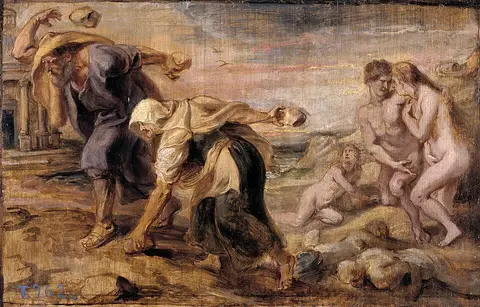
In Ovid, Deucalion and Pyrrha, alone in an empty world, go to the shrine of Themis. The goddess answers in a riddle: 'Throw the bones of your great mother behind you.' Pyrrha is horrified; Deucalion solves it: the great mother is the earth, and her bones are stones. The stones Deucalion throws become men, those Pyrrha throws become women.
Ovid, Metamorphoses 1.313–415Stones and people
Apollodorus links the Greek word for 'people', laos, to laas, 'stone'. Pindar too says that Deucalion and Pyrrha made a people out of stones.
Apollodorus, Library 1.7.2; Pindar, Olympian 9.41–53Stories featuring Deucalion
Quick questions
- Who are Deucalion's parents?
- In the main account, Deucalion's father is Prometheus. The mother is not named in this account. Apollodorus, Library 1.7.2
- Who were Deucalion's consorts and lovers?
- The partners named in the sources: Pyrrha.
- Who are Deucalion's children?
- This atlas records 1 child of Deucalion: Hellen. See the family tree →
- What are Deucalion's symbols?
- Chest (ark), Stones.
- Which myths is Deucalion in?
- Lycaon: the king who became a wolf · Deucalion and the great flood.
Ancient sources
This page is based on the texts below. Numbers refer to books and lines.
- Apollodorus, Library 1.7.2–1.7.3
- Ovid, Metamorphoses 1.313–415
- Pindar, Olympian 9.41–53