Deucalion and the great flood
Zeus destroys a corrupt human race with a flood. Warned by Prometheus, Deucalion and Pyrrha build a chest and survive, and new people spring from the stones they throw over their shoulders.
In this story
-
The ages of mankind
Hesiod tells the history of humankind in metals. The Golden race, who lived in the time of Cronus, were as carefree as gods. The Silver race that followed were irreverent. The Bronze race loved war and were strong and pitiless. Then came the race of heroes. Hesiod saw his own time as the worst of all: the race of Iron.
Apollodorus says Zeus wished to destroy the Bronze race.
Hesiod, Works and Days 106–201; Apollodorus, Library 1.7.2 -
The chest
Prometheus warned his son Deucalion. Deucalion built a chest, filled it with provisions and climbed into it with his wife Pyrrha, the daughter of Epimetheus and Pandora.
Zeus poured down rain from the sky and flooded most of Greece. Humankind perished; only a few who fled to the high mountains survived.
Apollodorus, Library 1.7.2 -
On Parnassus
The chest drifted for nine days and nine nights and came to rest on Mount Parnassus. When the waters went down, Deucalion sacrificed to Zeus, and Zeus sent Hermes to grant him a wish. Deucalion asked for new people.
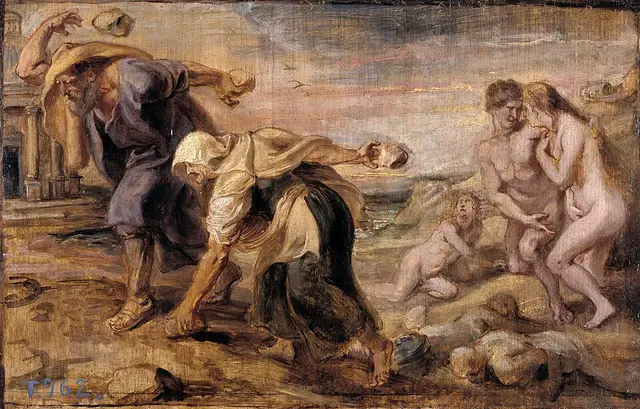
In Ovid the couple go to the temple of Themis, and the goddess answers with a riddle: 'Throw the bones of your great mother behind you.' Pyrrha is horrified at first, but Deucalion solves it: the great mother is the earth, and her bones are stones.
Apollodorus, Library 1.7.2; Ovid, Metamorphoses 1.313–394 -
People from stones
The stones Deucalion threw over his shoulder became men, and those Pyrrha threw became women. Apollodorus links the Greek word for 'people', laos, with laas, 'stone'.
Their son Hellen gave his name to the Greeks, who still call themselves Hellenes.
Apollodorus, Library 1.7.2–1.7.3; Ovid, Metamorphoses 1.395–415
Deucalion and the great flood: common questions
Who were Deucalion and Pyrrha?
Deucalion was the son of Prometheus; his wife Pyrrha was the daughter of Epimetheus and Pandora. Warned by Prometheus, they built a chest, rode out the flood Zeus sent to destroy the Bronze race, and became the ancestors of the new humanity. Their son Hellen gave his name to the Greeks, who still call themselves Hellenes.
Apollodorus, Library 1.7.2Where did Deucalion's ark land?
After drifting for nine days and nights, the chest came to rest on Mount Parnassus. When the waters went down, Deucalion sacrificed to Zeus, who sent Hermes to grant him a wish; he asked for new people.
Apollodorus, Library 1.7.2How were people made from stones?
In Ovid, the goddess Themis tells the couple to throw "the bones of your great mother" behind them. Deucalion solves the riddle: the great mother is the earth and her bones are stones. The stones he threw became men, and those Pyrrha threw became women.
Ovid, Metamorphoses 1.313–415Ancient sources
- Hesiod, Works and Days 106–201
- Apollodorus, Library 1.7.2–1.7.3
- Ovid, Metamorphoses 1.163–415
- Pindar, Olympian 9.41–53