The wedding of Peleus and Thetis
Zeus and Poseidon both court the sea goddess Thetis, but a prophecy says her son will be greater than his father. The gods marry her to the mortal Peleus. At this wedding, attended by all the gods, the apple thrown by Eris starts the Trojan War.
In this story
-
A dangerous prophecy
Pindar says Zeus and Poseidon compete for Thetis, daughter of Nereus. Themis prophesies that if Thetis bears a child to a god, it will be stronger than its father's thunderbolt or Poseidon's trident. The gods give her up.
Apollodorus adds that some say it was Prometheus who revealed the prophecy. In Aeschylus' Prometheus Bound, Prometheus says he knows the secret of a marriage that will overthrow Zeus. That secret is also the key to his release.
Pindar, Isthmian 8.26–47; Apollodorus, Library 3.13.5; Aeschylus, Prometheus Bound 907–927 -
The shape-shifting bride
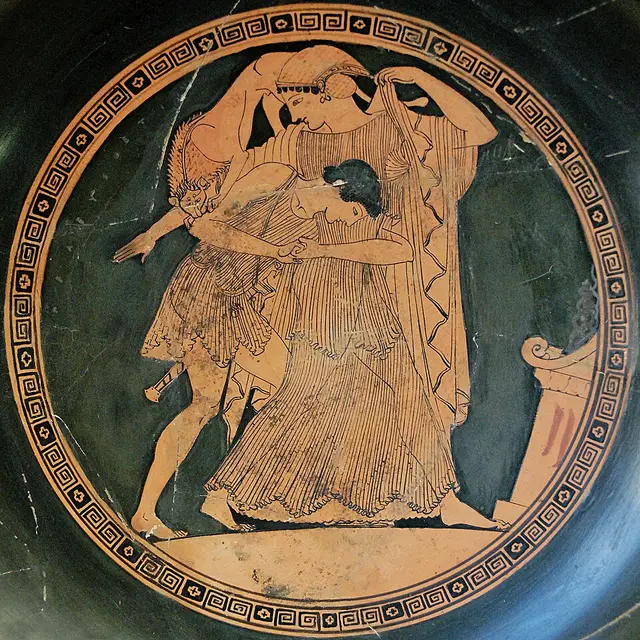
Thetis does not want to marry a mortal. Peleus catches her on the seashore. In Apollodorus she turns into fire, water and a wild beast; in Ovid she becomes first a bird, then a tree, then a tigress. Peleus holds on, and at last Thetis returns to her own shape and accepts the marriage.
Apollodorus, Library 3.13.5; Ovid, Metamorphoses 11.221–265 -
The wedding on Pelion
The wedding is held on Mount Pelion, where the centaur Chiron lives. All the gods come with gifts, and the Muses sing. Chiron gives Peleus a spear of ash wood, which Achilles will later carry. Poseidon gives the immortal horses Balius and Xanthus.
On the famous François Vase the gods arriving for the wedding are shown as a long procession.
Apollodorus, Library 3.13.5; Homer, Iliad 16.140–144, 16.866–867; François Vase, Florence Archaeological Museum -
The golden apple
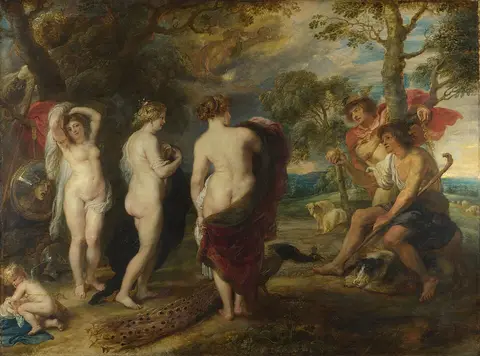
Eris, goddess of strife, is not invited. In anger she throws onto the table a golden apple inscribed 'to the fairest'. Hera, Athena and Aphrodite all claim it. Zeus leaves the decision to Paris, a herdsman on Mount Ida. The Trojan War begins with that judgement.
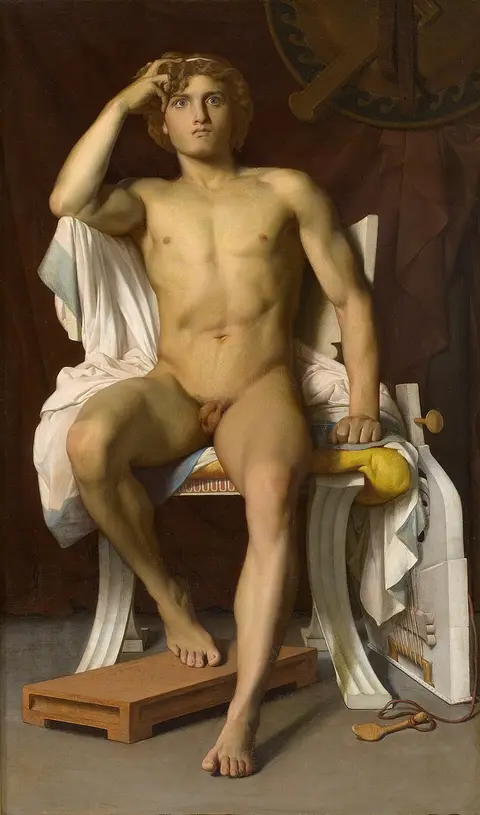
The child born of this marriage is Achilles, and the prophecy comes true in him too: he becomes a far greater hero than his father.
Cypria (summary by Proclus); Hyginus, Fabulae 92
Ancient sources
- Pindar, Isthmian 8
- Apollodorus, Library 3.13.5
- Ovid, Metamorphoses 11.221–265
- Catullus 64
- Cypria (summary by Proclus)