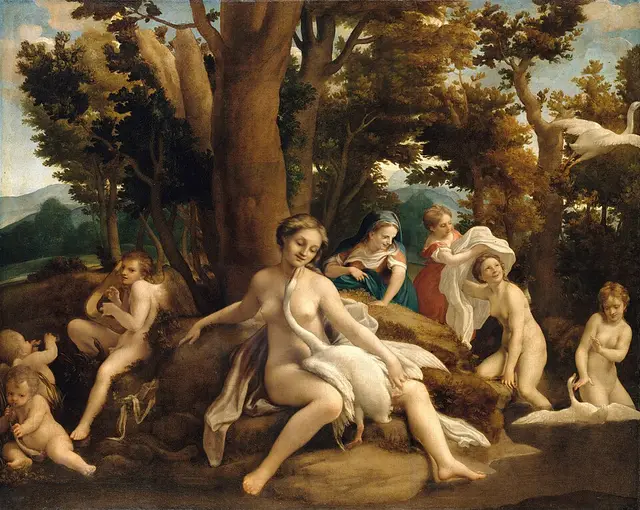
In this story
-
The swan
Leda, daughter of King Thestius of Aetolia, is the wife of Tyndareus, king of Sparta. Apollodorus says Zeus came to her in the form of a swan, and that the same night Tyndareus slept with her too.
Euripides tells it a little differently: Zeus, disguised as a swan fleeing from an eagle, took refuge in Leda's lap. His Helen tells the tale with an 'if the story is true'.
Apollodorus, Library 3.10.5–3.10.7; Euripides, Helen 16–22 -
Four children, two fathers
According to Apollodorus, Polydeuces and Helen were the children of Zeus, Castor and Clytemnestra those of Tyndareus. So Helen and Clytemnestra were half-sisters: one would cause the Trojan War, the other would kill Agamemnon.
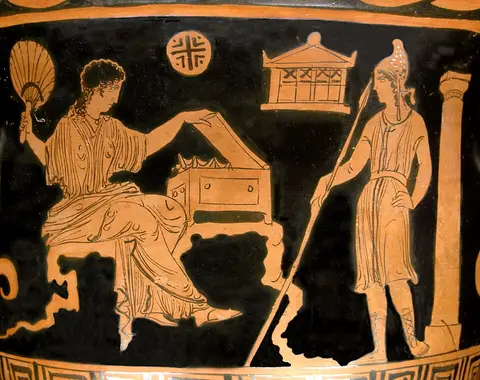
Apollodorus records another version too: Helen was really the daughter of Zeus and Nemesis. Fleeing Zeus, Nemesis turned into a goose and Zeus into a swan. A shepherd found the egg she laid and brought it to Leda, who kept it in a chest; Helen hatched from it, and Leda raised her as her own.
Apollodorus, Library 3.10.7 -
Twins who shared immortality
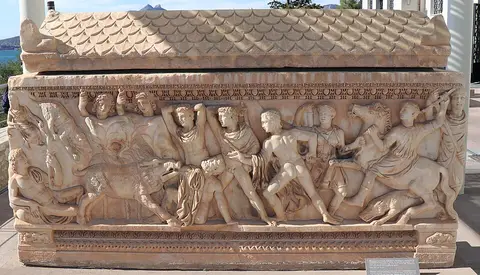
Castor and Polydeuces are known as the Dioscuri, the 'sons of Zeus'. They fought their cousins Idas and Lynceus over a herd of cattle, and Castor was killed. In Pindar, the immortal Polydeuces would not be parted from his brother, and Zeus gave him a choice; he chose to share his immortality, so the twins spend half their days under the earth and half on Olympus.
The Odyssey, too, says that Castor and Polydeuces live beneath the earth, alive one day and dead the next, honoured like gods. Sailors called on them as protectors of ships in storms.
Pindar, Nemean 10.55–90; Homer, Odyssey 11.298–304; Apollodorus, Library 3.11.2; Homeric Hymn to the Dioscuri (33)
Ancient sources
- Apollodorus, Library 3.10.5–3.11.2
- Euripides, Helen 16–22
- Homer, Odyssey 11.298–304
- Pindar, Nemean 10.55–90