Helen in Egypt: the woman who never went to Troy
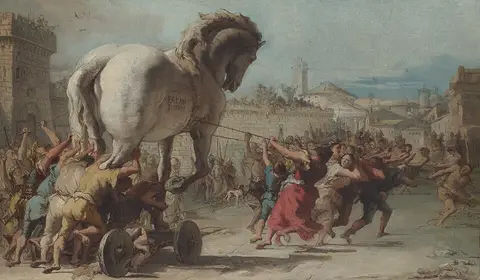
In the story the Greeks knew, Helen runs away to Troy with Paris and the ten-year war is fought because of her. But some ancient writers told it differently: Helen never went to Troy at all, and the war was fought over a phantom.
In this story
-
The poet who went blind
Plato reports that the poet Stesichorus went blind after writing a poem that slandered Helen. Understanding why, he wrote a new poem, a palinode ('taking back'): 'That story is not true. You did not board the well-decked ships, you did not go to the citadel of Troy.' According to Plato, Stesichorus then regained his sight.
Plato, Phaedrus 243a–b; Stesichorus, fr. 192–193 -
Herodotus' Egyptian priests
Herodotus passes on a story he heard from Egyptian priests. As Paris sails home with Helen, a storm drives him to Egypt. The Egyptian king Proteus expels Paris for breaking the laws of hospitality, but keeps Helen with him to return her to her husband.
The Greeks besiege Troy. The Trojans swear that Helen is not in the city, but cannot make the Greeks believe them. Only when the city falls do the Greeks learn the truth, and Menelaus goes to Egypt to fetch Helen. Herodotus says Homer knew this version too but chose the one better suited to his epic.
Herodotus 2.112–120 -
Euripides' phantom
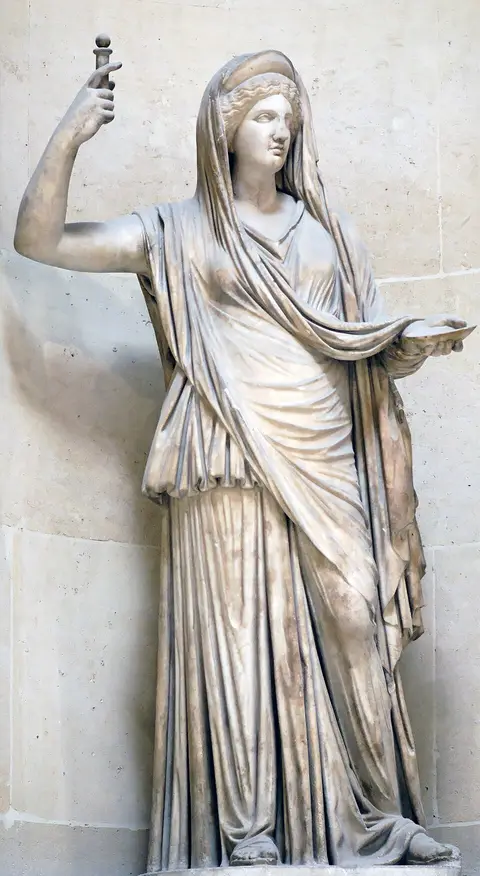
In Euripides' tragedy Helen, Hera, angry that Paris chose Aphrodite over her, gives him a phantom (eidolon) of Helen. Hermes carries the real Helen to Egypt, to King Proteus.
For ten years Greeks and Trojans fight over a phantom. After the war Menelaus wanders the seas for seven years, until a storm wrecks him in Egypt. There he meets the real Helen, and the two escape by a trick. The play is a bitter joke that questions the meaning of the Trojan War.
Euripides, Helen 1–67, 766–776
Helen in Egypt: the woman who never went to Troy: common questions
Who was Stesichorus, and what did he say about Helen?
A lyric poet of the 6th century BC from Himera in Sicily. Plato tells that he was struck blind after writing a poem that slandered Helen, and wrote a "palinode", a recantation: the story is not true, she never boarded the ships and never went to Troy. His sight, says Plato, was then restored.
Plato, Phaedrus 243a–b; Stesichorus, fr. 192–193What does Herodotus say about Helen in Egypt?
Egyptian priests told Herodotus that a storm drove Paris to Egypt, where King Proteus kept Helen to return to her husband. The Trojans swore she was not in their city but were not believed; after Troy fell, Menelaus fetched her from Egypt. Herodotus thought Homer knew this version but chose the one better suited to epic.
Herodotus, Histories 2.112–120