Ceyx and Alcyone: love lost in a storm
King Ceyx sets sail to consult an oracle and drowns in a storm. A dream sent by the god of Sleep shows his wife Alcyone the truth, and the gods turn them both into seabirds. The calm 'halcyon days' of midwinter come from them.
In this story
-
Parting
Ceyx, son of the morning star Eosphorus, is king of Trachis. He and his wife Alcyone love each other dearly. After his brother's death and a run of evil omens, Ceyx decides to consult Apollo's oracle at Claros, on the coast of Ionia near today's İzmir.
Alcyone begs him not to leave her. She knows the sea and the winds well, for in Ovid her father is Aeolus, master of the winds. Ceyx promises to be back within two months and sets sail.
Ovid, Metamorphoses 11.410–473 -
The storm
Out on the open sea, the ship is caught in a terrible storm, which Ovid describes at length and vividly. The ship sinks. With his last breath Ceyx speaks Alcyone's name and prays that the waves will carry his body to her.
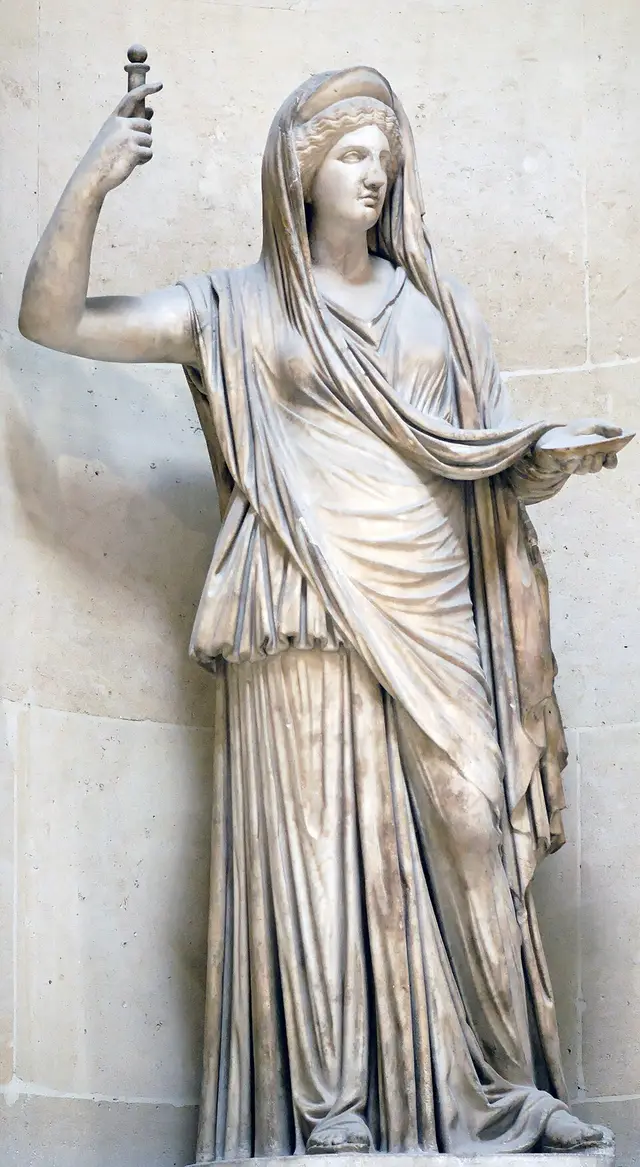
Every day Alcyone prays to Hera for her husband. Hera cannot bear prayers offered for a man already dead, and sends her messenger Iris to Hypnos, the god of Sleep.
Ovid, Metamorphoses 11.474–590 -
The cave of Sleep
Hypnos lives in a cave the sun never enters. Lethe, the river of forgetting, flows past it, and poppies grow at its door. Hypnos sends his son Morpheus, a master at imitating human forms.
Morpheus takes the shape of Ceyx and, pale and dripping, enters Alcyone's dream to tell her that he has drowned. The word 'morphine' comes from Morpheus's name.
Ovid, Metamorphoses 11.591–673 -
Halcyon days
In the morning Alcyone runs to the shore and sees the body the waves have brought in. As she tries to throw herself into the sea, she sprouts wings and becomes a seabird. The gods turn Ceyx into a bird too, and the two are together again.
Ovid says that for seven days in winter Alcyone sits on her eggs in her nest, and her father Aeolus holds back the winds so that the sea is calm. These quiet days in midwinter are called 'halcyon days', the origin of the English phrase. The halcyon is thought to be the kingfisher.
Apollodorus tells a harsher ending: the couple grow so proud that they call themselves Zeus and Hera, and Zeus punishes them by turning them into birds.
Ovid, Metamorphoses 11.674–748; Apollodorus, Library 1.7.4
Ancient sources
- Ovid, Metamorphoses 11.410–748
- Apollodorus, Library 1.7.4
- Hyginus, Fabulae 65
- Aristotle, History of Animals 5.8