Io: the priestess turned into a cow
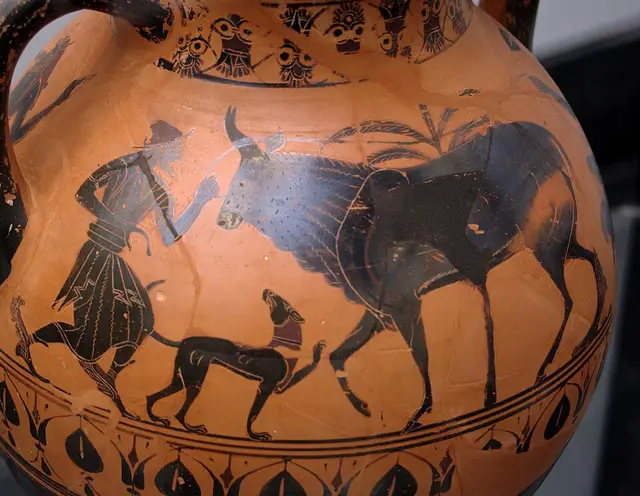
Zeus falls in love with Io, a priestess of Hera, and turns her into a cow to hide her from his wife. Hera claims the cow, sets hundred-eyed Argus to guard her, then drives her to the ends of the earth with a gadfly. Io's journey crosses from Europe into Asia and ends in Egypt.
In this story
-
Priestess and cow
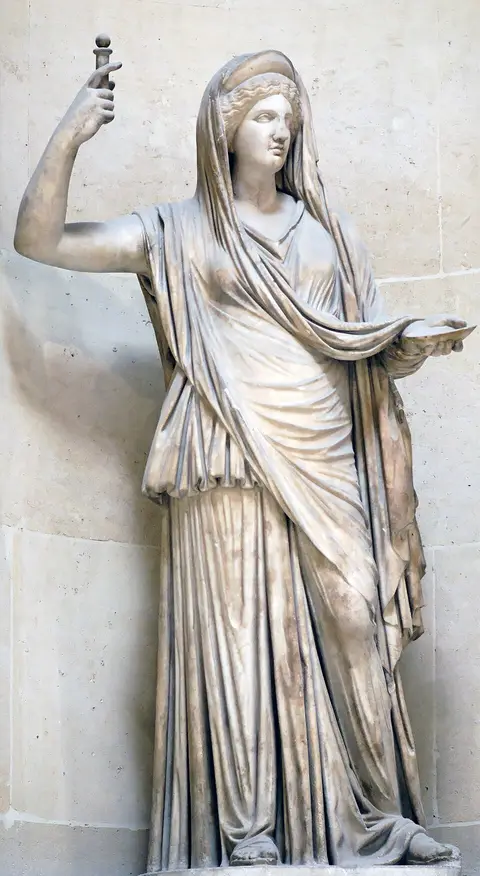
Io is a priestess of Hera at Argos. Apollodorus lists different accounts of her father; in the most common one he is the river god Inachus.
Zeus falls in love with her. When Hera is about to catch them, Zeus turns the girl into a white cow and swears he has had nothing to do with her. Since Hesiod, the saying that 'a lover's oath does not anger the gods' has been traced to this moment.
Apollodorus, Library 2.1.3; Hesiod, fragment 124 -
The hundred-eyed guard
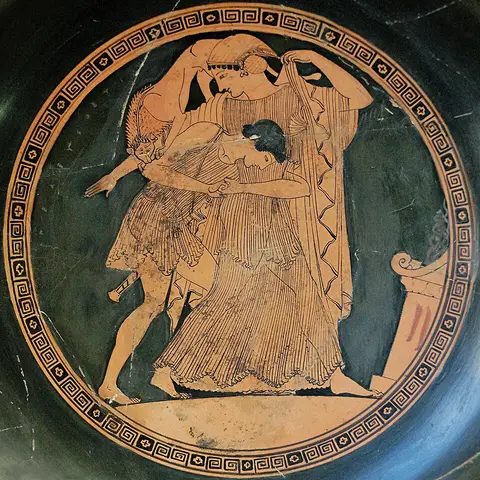
Hera asks for the cow as a gift, and Zeus cannot refuse. She sets the giant Argus, whose body is covered in eyes, to guard it. Some of his eyes sleep while the others always stay open.
Zeus sends Hermes. Ovid says Hermes played his pipes and told stories until every one of Argus's eyes closed, then cut off his head. Hermes's title 'Argeiphontes' is thought to mean 'slayer of Argus'. Hera placed Argus's eyes in the tail of her sacred bird, the peacock.
Apollodorus, Library 2.1.3; Ovid, Metamorphoses 1.583–723 -
The gadfly
Next Hera sends a gadfly that stings Io without rest, and Io flees. The Ionian Sea, along whose shore she passes, is named after her. The strait where she swims from Europe to Asia is called Bosporus, 'the cow's crossing'.
In Aeschylus's Prometheus Bound, Io meets Prometheus chained to his rock. He tells her the rest of her journey, and says that a hero descended from her, Heracles, will free him from his chains.
Aeschylus, Prometheus Bound 561–886; Apollodorus, Library 2.1.3 -
In Egypt
At last Io reaches the banks of the Nile. Zeus touches her and she returns to human form. Her son is named Epaphus, 'touch'. The Greeks later identified Io with the Egyptian goddess Isis, and Epaphus with the sacred bull Apis.
From Io descend Danaus and Aegyptus, and from them Danae, Perseus and Heracles. So when Heracles frees Prometheus, he is one of Io's descendants.
Apollodorus, Library 2.1.3–2.1.4; Herodotus 2.41
Ancient sources
- Aeschylus, Prometheus Bound
- Aeschylus, Suppliants
- Apollodorus, Library 2.1.3
- Ovid, Metamorphoses 1.583–750