Philoctetes on Lemnos: the wounded archer
The archer Philoctetes, heir to the bow of Heracles, is bitten by a snake on the way to Troy. Unable to bear the stench of his wound and his cries, the Greeks leave him alone on the island of Lemnos. Ten years later it turns out that Troy can only be taken with his bow.
In this story
-
The snakebite
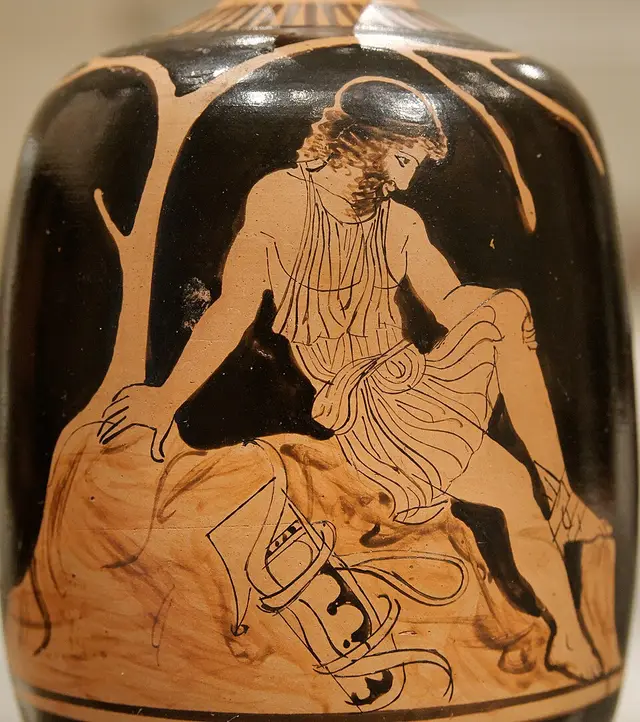
Philoctetes inherited the bow and arrows of Heracles because he lit Heracles' pyre on Mount Oeta. Sailing to Troy with the Greek fleet, he is bitten on the foot by a snake on an island during a sacrifice.
The wound will not heal and gives off a stench. Philoctetes screams with pain. On the advice of Odysseus, the Greeks put him ashore on Lemnos. The Iliad says that as he lies there in agony, the Greeks will soon remember him.
Homer, Iliad 2.716–725; Apollodorus, Epitome 3.27 -
The prophecy
Ten years later the Greeks learn from Helenus, a Trojan seer they have captured, that Troy can only be taken with the bow of Heracles. They go to Lemnos to fetch Philoctetes.
In Sophocles' Philoctetes the task falls to Odysseus and to Neoptolemus, Achilles' young son. Odysseus wants Neoptolemus to get the bow by lying. The honest Neoptolemus is torn between his conscience and Odysseus's orders, and in the end gives the bow back to Philoctetes.
Philoctetes refuses to come. At the end of the play Heracles appears from the heavens and tells him to go to Troy.
Sophocles, Philoctetes; Apollodorus, Epitome 5.8 -
The death of Paris
Philoctetes comes to Troy. Machaon, the healer son of Asclepius, cures his wound. With the bow of Heracles Philoctetes shoots and kills Paris, and the fall of Troy draws near.
Little Iliad (summary by Proclus); Apollodorus, Epitome 5.8
Ancient sources
- Sophocles, Philoctetes
- Homer, Iliad 2.716–725
- Apollodorus, Epitome 3.27, 5.8
- Little Iliad (summary by Proclus)