The nine daughters of Zeus and Mnemosyne, the goddess of memory. They inspire poets and artists. Both Homer and Hesiod open their poems by calling on them.
In brief
- Zeus lies with Mnemosyne for nine nights and nine daughters are born: Clio, Euterpe, Thalia, Melpomene, Terpsichore, Erato, Polyhymnia, Urania and Calliope. Hesiod says Calliope is the foremost of them.
- Hesiod tells how the Muses appeared to him while he was tending sheep on Mount Helicon. They gave him a laurel staff and made him a poet.
- The Iliad begins 'Sing, goddess, the wrath', the Odyssey 'Tell me, Muse, of the man'.
Family
Siblings
½ Half-sibling: only one parent in common.
To see the whole family, open the Muses family tree → · how is Muses related to Zeus? → · compare with someone else →
Which Muse is which?
Giving each Muse her own field became fixed only in Roman times: Calliope epic, Clio history, Euterpe the aulos and lyric poetry, Thalia comedy, Melpomene tragedy, Terpsichore dance, Erato love poetry, Polyhymnia hymns, Urania astronomy.
Hesiod has no such division. The Muses sing and dance together.
Hesiod, Theogony 75–79Museum and music
The word 'museum' comes from 'mouseion', a shrine of the Muses. The most famous was the Mouseion of Alexandria. It was a centre of research, and the famous library belonged to it.
The word 'music' comes from 'mousike', the art of the Muses.
Strabo, Geography 17.1.8Muses in art
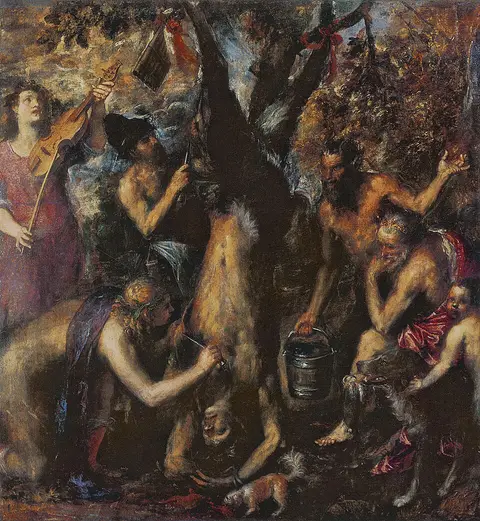
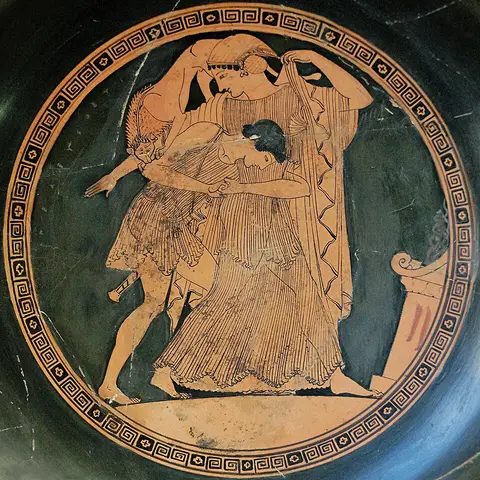
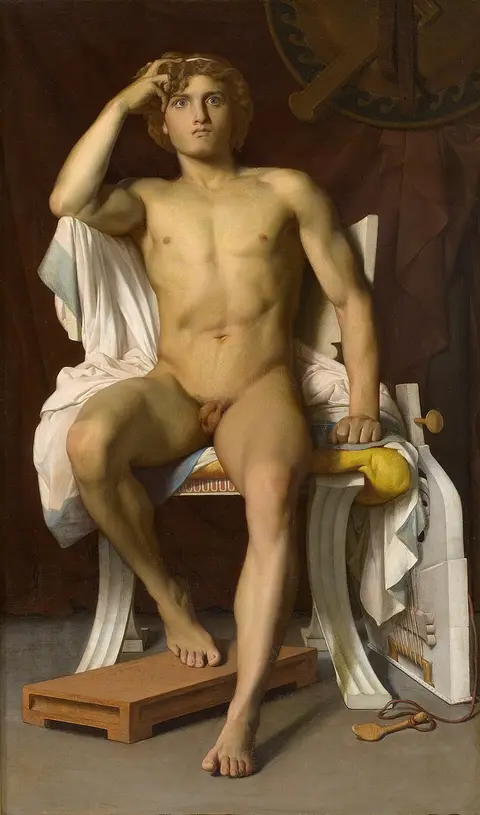
16works depicting Muses, in date order, from ancient vases to paintings of the Renaissance and after. All are in the public domain or openly licensed. Click an image for the full-size version and licence details. For scene-by-scene readings of famous vases, see Greek vase painting.


Stories featuring Muses
Quick questions
- Who are Muses' parents?
- In the main account, Muses' father is Zeus and mother is Mnemosyne. Hesiod, Theogony 53–62, 915–917
- What are Muses' symbols?
- Lyre, Scroll, Mask.
- Which myths is Muses in?
- Marsyas: the satyr who challenged Apollo · The wedding of Peleus and Thetis · The death of Achilles.
Ancient sources
This page is based on the texts below. Numbers refer to books and lines.
- Hesiod, Theogony 1–115, 915–917
- Homer, Iliad 1.1, 2.484–492
- Homer, Odyssey 1.1
- Apollodorus, Library 1.3.1