Marsyas: the satyr who challenged Apollo
The Phrygian satyr Marsyas finds the double flute Athena threw away and plays it so well that he challenges Apollo. He loses, and his punishment is terrible. The story is set at ancient Celaenae, today's Dinar in Afyonkarahisar.
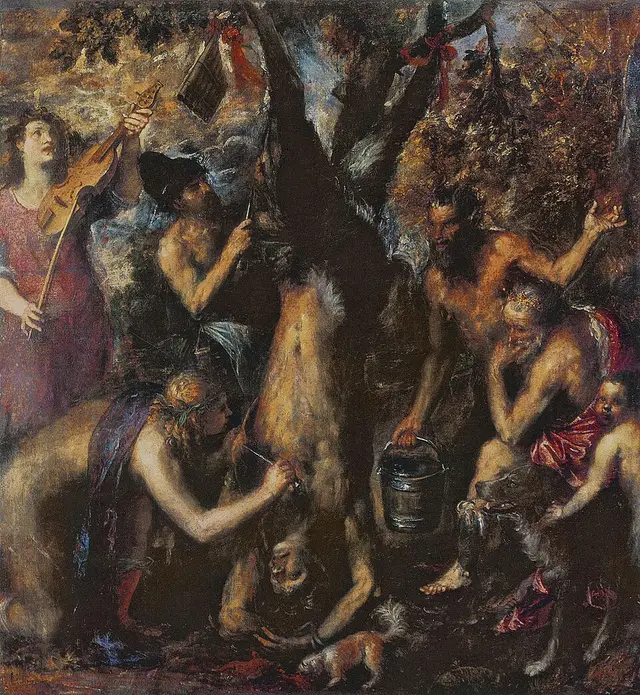
Titian · Public domain · Wikimedia Commons
In this story
-
The flute Athena threw away
According to ancient tradition, Athena invented the double-piped flute, the aulos. But as she played she saw her puffed-out cheeks reflected in water, thought it made her ugly and threw the flute away; in some versions she also cursed whoever picked it up. The Phrygian satyr Marsyas found it. He practised until he became a master, and finally challenged Apollo and his lyre to a contest.
Apollodorus, Library 1.4.2; Ovid, Fasti 6.697–710; Hyginus, Fabulae 165 -
The contest
The winner was to do whatever he liked with the loser. Apollodorus says Apollo turned his lyre upside down and played it, and told Marsyas to do the same, which cannot be done with a flute. In Hyginus the Muses are the judges. Apollo hung Marsyas from a pine tree and flayed him alive. In Ovid, Marsyas cries out in agony: 'Is a flute worth this much?'
Apollodorus, Library 1.4.2; Hyginus, Fabulae 165; Ovid, Metamorphoses 6.382–391 -
The river Marsyas
Ovid says the country gods, satyrs and nymphs wept for Marsyas, and their tears soaked into the earth and became the clearest river in Phrygia, which bears his name. Herodotus and Xenophon describe the source of this river at Celaenae, and the cave where the skin of Marsyas was hung. Xenophon says the river rose beneath the palace of the Persian king. Celaenae is today's Dinar, and the river is one of the headwaters of the Büyük Menderes, the ancient Maeander.
Ovid, Metamorphoses 6.392–400; Herodotus 7.26; Xenophon, Anabasis 1.2.8 -
Two contests confused
Ovid tells of another contest involving Apollo, against Pan on Mount Tmolus (Bozdağ). There King Midas preferred Pan, and Apollo gave him donkey's ears. The two contests were often confused in later times. The flaying of Marsyas became a favourite subject of Renaissance painters, most famously in Titian's late painting.
Ovid, Metamorphoses 11.146–193
Ancient sources
- Apollodorus, Library 1.4.2
- Ovid, Metamorphoses 6.382–400
- Ovid, Fasti 6.697–710
- Hyginus, Fabulae 165
- Herodotus 7.26
- Xenophon, Anabasis 1.2.8