Skip to content
Deity · Greek mythology

Satyrs

Σάτυροι

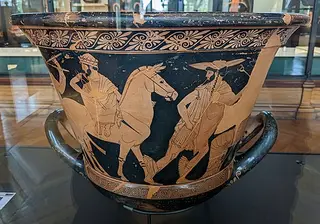
The merry, wine-loving and mischievous companions of Dionysus. In Greek art they have horse's ears and a horse's tail. The goat-legged satyr came later, from the Roman fauns.

In brief

  1. In a fragment of Hesiod quoted by Strabo they are called 'the race of worthless satyrs, unfit for work'.
  2. In the train of Dionysus they dance, drink wine and play music with the maenads.
  3. On Greek vases they have horse's ears, a horse's tail and a snub nose. In later times they merge with Pan and the Roman fauns and gain goat's legs.

Family

Parents

No parents: one of the first beings.

To see the whole family, open the Satyrs family tree → · how is Satyrs related to Zeus? → · compare with someone else →

The satyr play

At the festivals of Dionysus in Athens, the tragic poets staged a 'satyr play' after their three tragedies. Its chorus was made up of satyrs, and it made the audience laugh after the weight of the tragedies.

The only satyr play that survives complete is Euripides' 'Cyclops'. It tells of Odysseus' encounter with Polyphemus through the eyes of the satyrs.

Euripides, Cyclops

Marsyas

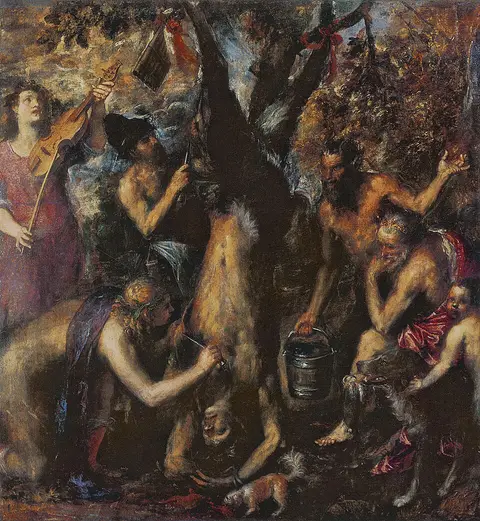
Marsyas of Phrygia, who challenged Apollo to a music contest and was flayed, is also described as a satyr (or a silenus). Herodotus says his skin hung at Celaenae, today Dinar.

Herodotus, Histories 7.26

Satyrs on Greek vases

Satyrs in art

15works depicting Satyrs, in date order, from ancient vases to paintings of the Renaissance and after. All are in the public domain or openly licensed. Click an image for the full-size version and licence details. For scene-by-scene readings of famous vases, see Greek vase painting.

Amphora depicting Satyrs, Micali Painter
Amphora depicting SatyrsMicali Painter · 600 BCMartin von Wagner MuseumCC BY-SA 4.0 · Photo: ArchaiOptix
Porringer depicting Satyrs, Bowdoin Painter
Porringer depicting SatyrsBowdoin Painter · 600 BCMartin von Wagner MuseumCC BY-SA 4.0 · Photo: ArchaiOptix
Terracotta kylix: band-cup (drinking cup), Oakeshott Painter
Terracotta kylix: band-cup (drinking cup)Oakeshott Painter · 600 BCMetropolitan Museum of ArtCC0
Terracotta aryballos signed by Nearchos, Nearchos
Terracotta aryballos signed by NearchosNearchos · 569 BCMetropolitan Museum of ArtCC0
Terracotta column-krater (bowl for mixing wine and water), Lydos
Terracotta column-krater (bowl for mixing wine and water)Lydos · 549 BCMetropolitan Museum of ArtCC0
terracotta kylix, Makron
terracotta kylixMakronMetropolitan Museum of ArtCC0
satyr and Dionysos - women or maenads at the Lenaia, Hieron, Makron
satyr and Dionysos - women or maenads at the LenaiaHieron, MakronAntikensammlung BerlinCC BY-SA 4.0 · Photo: Makron
Venus and Mars, Sandro Botticelli
Venus and MarsSandro Botticelli · 1485National GalleryPublic domain
Triumph of the Virtues, Andrea Mantegna
Triumph of the VirtuesAndrea Mantegna · 1487Department of Paintings of the LouvrePublic domain
Wedding of Peleus and Thetis, Bartolomeo di Giovanni
Wedding of Peleus and ThetisBartolomeo di Giovanni · 1490Department of Paintings of the LouvrePublic domain
The Death of Procris, Piero di Cosimo
The Death of ProcrisPiero di Cosimo · 1495National GalleryPublic domain
Combat of Love and Chastity, Pietro Perugino
Combat of Love and ChastityPietro Perugino · 1503Department of Paintings of the LouvrePublic domain
Satyr's Family, Jacopo de' Barbari
Satyr's FamilyJacopo de' Barbari · 1503National Gallery of Art, Prints in the National Gallery of ArtCC0
Allegory of Chastity, Lorenzo Lotto
Allegory of ChastityLorenzo Lotto · 1505National Gallery of Art, Samuel H. Kress CollectionPublic domain
The Satyr Family, Alberto Durero
The Satyr FamilyAlberto Durero · 1505Art Institute of Chicago, Cleveland Museum of ArtPublic domain · Photo: Albrecht Dürer

Stories featuring Satyrs
Quick questions

What are Satyrs' symbols?
Horse's ears and tail, Pipes, Wine cup.
Which myths is Satyrs in?
Marsyas: the satyr who challenged Apollo.

Ancient sources

This page is based on the texts below. Numbers refer to books and lines.