Arachne and Athena
A young Lydian weaver claims she is more skilful than Athena herself. The contest is flawless, but it ends with a spider. The whole story takes place in Lydia, in Anatolia.
In this story
-
The weaver of Lydia
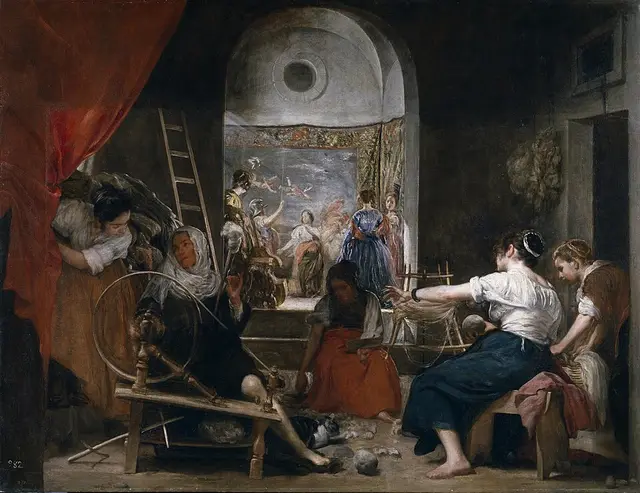
Arachne is the daughter of Idmon, a dyer from Colophon, and lives in the small Lydian town of Hypaepa. She comes from no noble family and no famous city, yet her weaving is famous throughout Lydia; even the nymphs of Mount Tmolus and the river Pactolus come to watch her work. Everyone assumes she was taught by Athena. Arachne is offended and says she is ready to compete with the goddess.
Ovid, Metamorphoses 6.1–25 -
The contest
Athena comes disguised as an old woman and advises her to ask the goddess's forgiveness. When Arachne answers back, Athena reveals herself, and the contest begins. Athena weaves her contest with Poseidon for Athens, and in the corners the punishments of mortals who defied the gods. Arachne weaves scenes of gods in disguise deceiving mortals: the bull that carried off Europa, Leda's swan, Danae's shower of gold.
Ovid, Metamorphoses 6.26–128 -
The spider
Neither Athena nor Envy can find a single flaw in Arachne's work. Furious, the goddess tears the cloth and strikes Arachne on the head with her shuttle. Arachne cannot bear it and hangs herself. Athena takes pity on her but does not lift the punishment: Arachne will live, but she and her descendants will hang and weave forever. Her hair falls out, her head shrinks and her body becomes a spider. The scientific name of the class of spiders, Arachnida, and the word 'arachnophobia' come from Arachne.
Ovid, Metamorphoses 6.129–145
Ancient sources
- Ovid, Metamorphoses 6.1–145