Athena and Poseidon: the contest for Athens
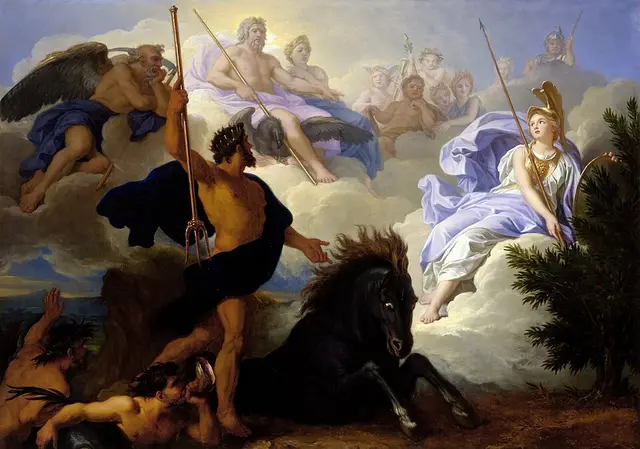
Athena and Poseidon compete to become the patron of Attica. Poseidon strikes the Acropolis with his trident and brings up salt water; Athena plants an olive tree. Athena wins, and the city takes her name.
In this story
-
Two gifts on the Acropolis
Apollodorus says the gods decided to choose cities where each would be worshipped. Poseidon came to Attica first, struck the rock of the Acropolis with his trident and brought up a 'sea', a spring of salt water.
Then Athena came and, calling King Cecrops as her witness, planted an olive tree.
Apollodorus, Library 3.14.1 -
The judges and an angry sea god
When the two quarrelled over the land, Zeus appointed judges: the twelve gods, according to some, or Cecrops and Cranaus, according to others. Cecrops testified that Athena had planted the olive first, so the land was awarded to her and the city was named Athens after her.
In his anger Poseidon flooded the Thriasian plain and put Attica under the sea.
Apollodorus, Library 3.14.1 -
The women's vote
A version told by the Roman scholar Varro says the Athenians decided by vote. The men voted for Poseidon and the women for Athena, and since there was one more woman than man, Athena won.
When the angry Poseidon flooded the land, the women were punished to appease him: they would no longer vote, their children would not take their mother's name, and they would not be called 'Athenian women'.
Augustine, City of God 18.9 (after Varro) -
The olive and the salt spring on the Acropolis
Herodotus says an olive tree and a salt spring were shown in the temple of Erechtheus on the Acropolis as witnesses of the contest. When the Persians burned the Acropolis in 480 BC, the olive burned too, but the next day the Athenians found a new shoot a cubit long growing from the stump.
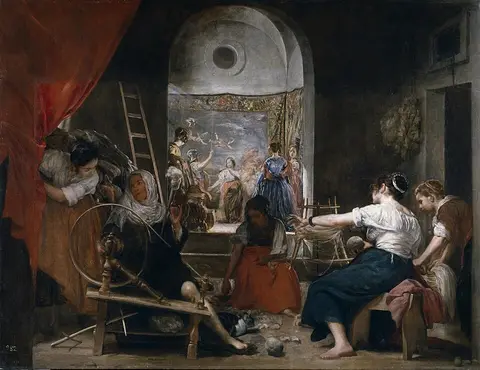
Pausanias says the west pediment of the Parthenon showed Athena and Poseidon disputing the land. In Ovid, Athena weaves this very scene in her contest with Arachne: Zeus among the twelve gods, Poseidon striking the rock, and Athena with an olive branch heavy with fruit.
Herodotus, Histories 8.55; Pausanias, Description of Greece 1.24.5, 1.26.5; Ovid, Metamorphoses 6.70–82
Ancient sources
- Apollodorus, Library 3.14.1
- Herodotus, Histories 8.55
- Pausanias, Description of Greece 1.24.5, 1.26.5
- Ovid, Metamorphoses 6.70–82
- Augustine, City of God 18.9