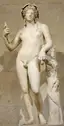
Dionysus and the Tyrrhenian pirates
Pirates seize a young man on the shore, taking him for a rich prince. His bonds fall away, wine flows over the ship and a vine wraps the mast. The young man is Dionysus. The pirates leap into the sea and become dolphins; only the helmsman who recognised the god is spared.
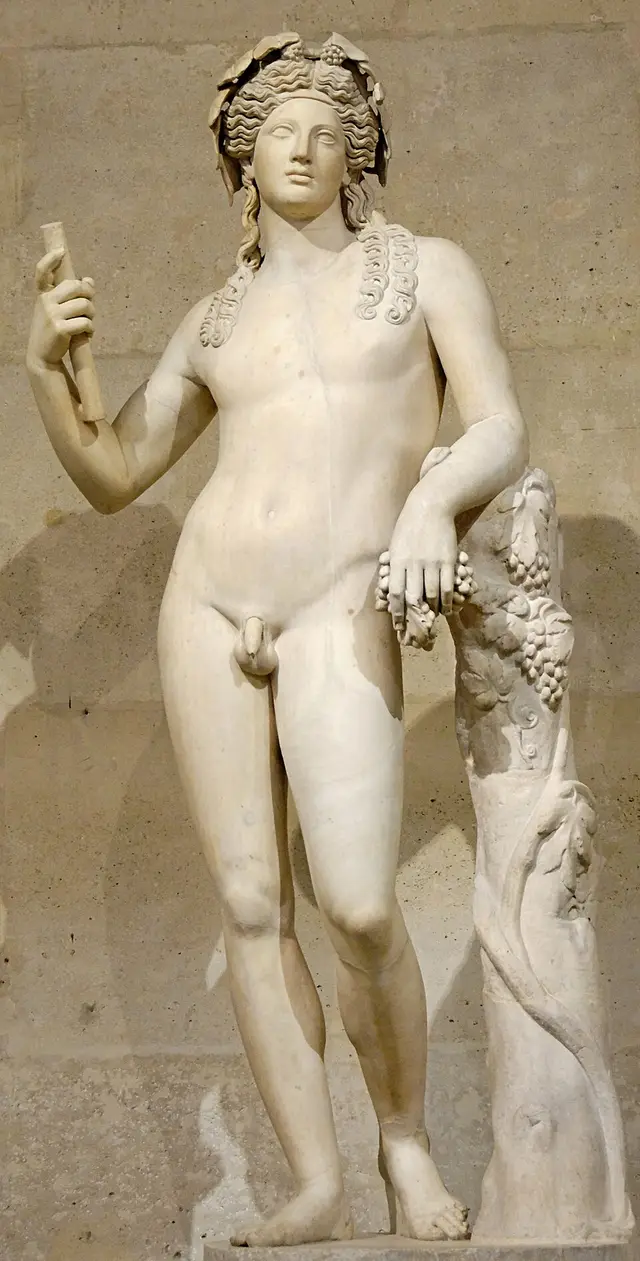
In this story
-
The young man on the shore
In the Homeric Hymn, Dionysus stands on the seashore in a purple cloak. Tyrrhenian pirates take him for a king's son and drag him aboard, hoping for a ransom.
They try to tie him up, but the ropes fall from his hands and feet. The helmsman realises he is a god and tells them to let him go at once. The captain laughs at him.
Homeric Hymn 7 to Dionysus 1–31 -
The vine and the lion
When the ship puts to sea, fragrant wine begins to flow over the deck. A vine heavy with grapes spreads along the top of the sail, and ivy twines around the mast.
The god turns into a roaring lion at the prow, and a bear appears amidships. The lion leaps on the captain. Terrified, the pirates jump into the sea and become dolphins.
Dionysus holds back the helmsman and tells him who he is: Dionysus, son of Semele and Zeus.
Homeric Hymn 7, 32–59 -
Acoetes in Ovid
In Ovid the story is told by the helmsman, Acoetes, the son of a poor fisherman from Maeonia in Lydia. Pentheus, king of Thebes, has arrested him as a worshipper of Dionysus, and Acoetes tells the king how he came to know the god.
In this version the pirates promise to take the boy to Naxos but turn the ship another way. Ivy binds the oars. Tigers, lynxes and spotted panthers appear around the god, and one by one the sailors turn into dolphins.
In Apollodorus, Dionysus hires a Tyrrhenian pirate ship to take him from Icaria to Naxos. The pirates sail past Naxos to sell him in Asia. The god turns the mast and oars into snakes and fills the ship with ivy and the sound of pipes.
Ovid, Metamorphoses 3.582–691; Apollodorus, Library 3.5.3 -
The cup of Exekias
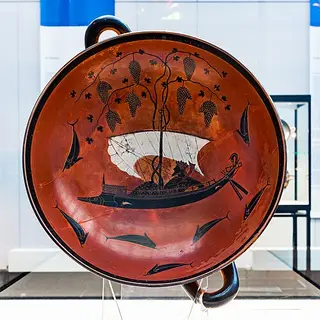
The most famous image of the story is a drinking cup by the Athenian potter and painter Exekias, from about 530 BC. Inside, Dionysus reclines alone in a ship, bunches of grapes hang from the mast, and seven dolphins swim around him. The cup is now in the Antikensammlungen in Munich.
On the frieze of the Lysicrates Monument in Athens (334 BC), satyrs punish the pirates, who leap into the sea turning into dolphins.
Cup of Exekias, Munich, Antikensammlungen 8729 (2044); Lysicrates Monument, Athens
This story on Greek vases
What each painter chose to show, scene by scene: Greek vase painting →
Ancient sources
- Homeric Hymn 7 to Dionysus
- Ovid, Metamorphoses 3.582–691
- Apollodorus, Library 3.5.3
- Hyginus, Fabulae 134
- Nonnus, Dionysiaca 45.105–168