Bellerophon and the Chimera
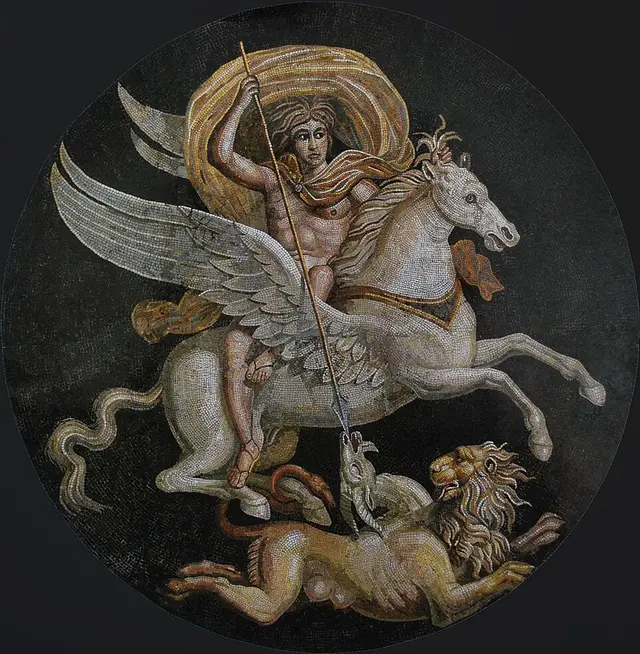
Sent to Lycia on a false charge, the young hero kills the fire-breathing Chimera with the winged horse Pegasus, then tries to ride up to the gods. In the Iliad, the story is told by a Lycian warrior.
Heroes and questsMonstersPride and punishmentSet in Anatolia
In this story
-
Friendship between enemies
In the Iliad, before the walls of Troy, the Greek Diomedes faces the Lycian Glaucus and asks who he is. Glaucus tells his ancestry: his grandfather was Bellerophon. Listening, Diomedes realises that their grandfathers were once each other's guests, so their families are bound by ancient ties of guest-friendship. Instead of fighting, the two warriors exchange armour. Homer notes that Glaucus trades gold armour for bronze.
Homer, Iliad 6.119–236 -
The sealed tablet
Anteia, wife of Proetus, king of Tiryns, falls for young Bellerophon. When he rejects her, she tells her husband that he tried to assault her. Proetus shrinks from killing a guest, so he sends him to his father-in-law in Lycia, carrying a folded tablet scratched with 'deadly signs'. These lines are the only reference to writing in Homer.
Homer, Iliad 6.155–170 -
Tasks in Lycia
The king of Lycia entertains his guest for nine days, and on the tenth reads the tablet. First he sends Bellerophon to kill the Chimera, a lion in front, a serpent behind and a goat in the middle, breathing fire. Bellerophon kills her, trusting in the signs of the gods; Pindar says he did it from the air, on the back of Pegasus. Then he fights the Solymi and the Amazons. On his way back he kills the best Lycian warriors, who lie in ambush for him on the king's orders. At last the king realises he is of divine descent and gives him his daughter and half his kingdom.
Homer, Iliad 6.171–195; Pindar, Olympian 13.84–90 -
Reaching for heaven
Pindar says Bellerophon tried to fly up to Olympus on Pegasus. Pegasus threw him off and rose into the sky alone. The Iliad describes Bellerophon's last years briefly and bitterly: hated by the gods, he wanders alone over the Aleian plain, avoiding the paths of men and eating his heart out. The Aleian plain is today's Çukurova, in ancient Cilicia.
Pindar, Isthmian 7.44–47; Homer, Iliad 6.200–202
Ancient sources
- Homer, Iliad 6.119–236
- Pindar, Olympian 13.63–92
- Apollodorus, Library 2.3.1–2.3.2
- Hesiod, Theogony 319–325