King of Lycia. A letter from his son-in-law Proetus asks him to kill the young man who brings it, Bellerophon. He will not kill his guest with his own hand, so he sends him on impossible tasks: the Chimera, the Solymi and the Amazons.
In brief
- In the Iliad he is the unnamed 'king of Lycia'. Apollodorus calls him Iobates. His daughter Stheneboea (Anteia in Homer) is the wife of Proetus, king of Argos.
- Proetus believes his wife's false accusation and wants to send Bellerophon to his death. Killing a guest would break the law of hospitality, so he sends him to Iobates with a letter, a folded tablet carrying 'deadly signs'. This is the only place in Homer where writing is mentioned.
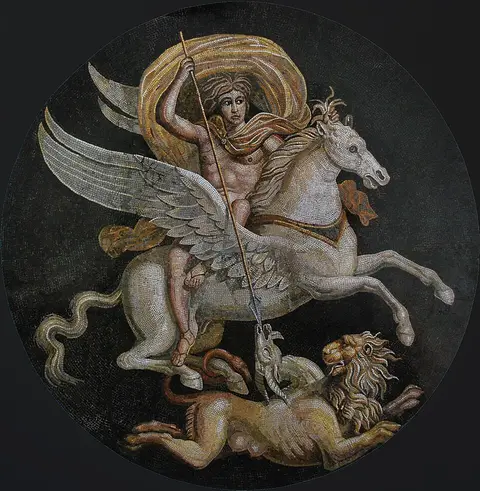
- Iobates does not kill his guest himself either. First he asks him to kill the fire-breathing Chimera. Then he sends him against the warlike Solymi, and after them against the Amazons. Finally he sets the best warriors of Lycia in ambush. Bellerophon defeats them all.
Family
Parents
No parents: one of the first beings.
Children
To see the whole family, open the Iobates family tree → · how is Iobates related to Zeus? → · compare with someone else →
The king who gave his daughter
Iobates realises that Bellerophon comes from the line of a god. He shows him the letter, gives him his daughter as a wife and leaves him half of his kingdom. The Lycians also set aside for him a share of their best land.
Apollodorus names the daughter Philonoe. Bellerophon's grandsons Sarpedon and Glaucus will lead the Lycians in the Trojan War.
Homer, Iliad 6.155–211; Apollodorus, Library 2.3.1–2.3.2Stories featuring Iobates
Quick questions
- Who are Iobates' children?
- This atlas records 2 children of Iobates: Anteia and Philonoe. See the family tree →
- Which myths is Iobates in?
- Bellerophon and the Chimera.
Ancient sources
This page is based on the texts below. Numbers refer to books and lines.
- Homer, Iliad 6.155–211
- Apollodorus, Library 2.2.1, 2.3.1–2.3.2
- Pindar, Olympian 13.84–92