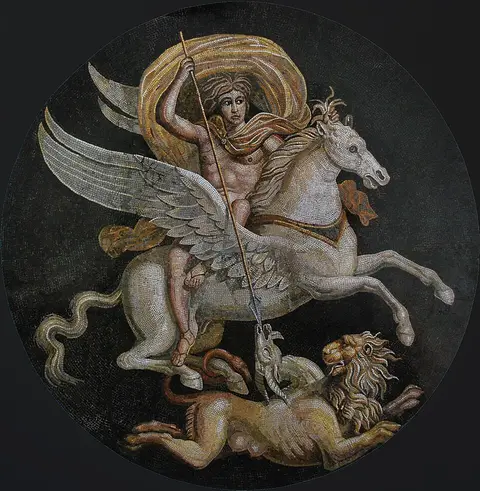
The fire-breathing monster of Lycia, part lion, part goat, part serpent, killed by Bellerophon from the back of Pegasus.
In brief
- The Iliad describes her as 'a lion in front, a serpent behind and a goat in the middle'. In Hesiod she has three heads: lion, goat and dragon.
- She lives in Lycia. The Iliad says she was raised by the Lycian Amisodarus.
- Bellerophon kills her, attacking from the air with arrows from the back of Pegasus.
Family
To see the whole family, open the Chimera family tree → · how is Chimera related to Zeus? → · compare with someone else →
The eternal flames of Yanartaş
Pliny mentions a Mount Chimaera near Phaselis that burns day and night. This is Yanartaş, above Çıralı near Kemer in Antalya, where natural gas seeping from the rocks has burned for thousands of years. It's no surprise that ancient visitors connected these flames that never go out with the lair of a fire-breathing monster.
Pliny, Natural History 2.236The Chimera of Arezzo, and chimeras
The most famous image of the Chimera is the Etruscan bronze found at Arezzo in Italy in 1553, now in the Archaeological Museum in Florence. In biology a 'chimera' is an organism containing cells from two different individuals, and in everyday English a chimera is an impossible dream.
Whose child?
In Hesiod's line, the 'she' who gives birth to the Chimera could be either Echidna or the Hydra. Most readers, and Apollodorus, make her the child of Typhon and Echidna.
Hesiod, Theogony 319; Apollodorus, Library 2.3.1Chimera in art
10works depicting Chimera, in date order, from ancient vases to paintings of the Renaissance and after. All are in the public domain or openly licensed. Click an image for the full-size version and licence details. For scene-by-scene readings of famous vases, see Greek vase painting.


Stories featuring Chimera
Quick questions
- Who are Chimera's parents?
- In the main account, Chimera's father is Typhon and mother is Echidna. Other accounts name other parents; the family box above lists them all with their sources. Apollodorus, Library 2.3.1
- What is Chimera's Roman name?
- In Roman mythology Chimera is known as Chimaera. All Greek and Roman names →
- What are Chimera's symbols?
- Lion's, goat's and serpent's heads, Fire.
- Which myths is Chimera in?
- Bellerophon and the Chimera.
Ancient sources
This page is based on the texts below. Numbers refer to books and lines.
- Homer, Iliad 6.179–183, 16.328–329
- Hesiod, Theogony 319–325
- Apollodorus, Library 2.3.1