The many-headed water serpent of Lerna. Every time Heracles cuts off a head, two grow back, until his nephew Iolaus sears the stumps with fire.
In brief
- The daughter of Typhon and Echidna. Hesiod says Hera raised her out of anger at Heracles.
- According to Apollodorus she has nine heads, eight mortal and the middle one immortal.
- Whenever Heracles cuts off a head, two new ones grow. His nephew Iolaus burns the necks with a torch to stop them growing back.
Family
To see the whole family, open the Hydra family tree → · how is Hydra related to Zeus? → · compare with someone else →
The labour that didn't count
Heracles cuts off the immortal head and buries it under a heavy rock. He dips his arrows in the Hydra's bile; these arrows will later kill the centaur Nessus and so bring about Heracles's own death. Eurystheus refuses to count this labour, because Heracles had help.
Apollodorus, Library 2.5.2The crab in the sky
During the fight Hera sends a giant crab to bite Heracles's foot. He crushes it, and Hera sets it among the stars: this is the constellation Cancer. Today 'hydra' is used for an organism that can regrow from cut pieces, and for any problem that keeps coming back however often you deal with it.
Apollodorus, Library 2.5.2; Eratosthenes, Catasterismi 11Hydra in art
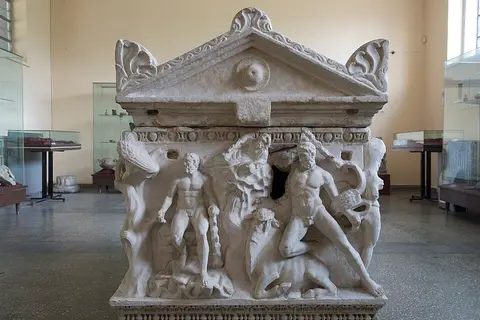
13works depicting Hydra, in date order, from ancient vases to paintings of the Renaissance and after. All are in the public domain or openly licensed. Click an image for the full-size version and licence details. For scene-by-scene readings of famous vases, see Greek vase painting.


Stories featuring Hydra
Quick questions
- Who are Hydra's parents?
- In the main account, Hydra's father is Typhon and mother is Echidna. Hesiod, Theogony 313–318
- Who are Hydra's children?
- This atlas records 1 child of Hydra: Chimera. See the family tree →
- What are Hydra's symbols?
- Many heads.
- Which myths is Hydra in?
- The twelve labours of Heracles.
Ancient sources
This page is based on the texts below. Numbers refer to books and lines.
- Hesiod, Theogony 313–318
- Apollodorus, Library 2.5.2
- Euripides, Heracles 419–424