Monster · Greek mythology
The winged lion with a woman's head who besieges Thebes with her riddle until Oedipus answers it.
In brief
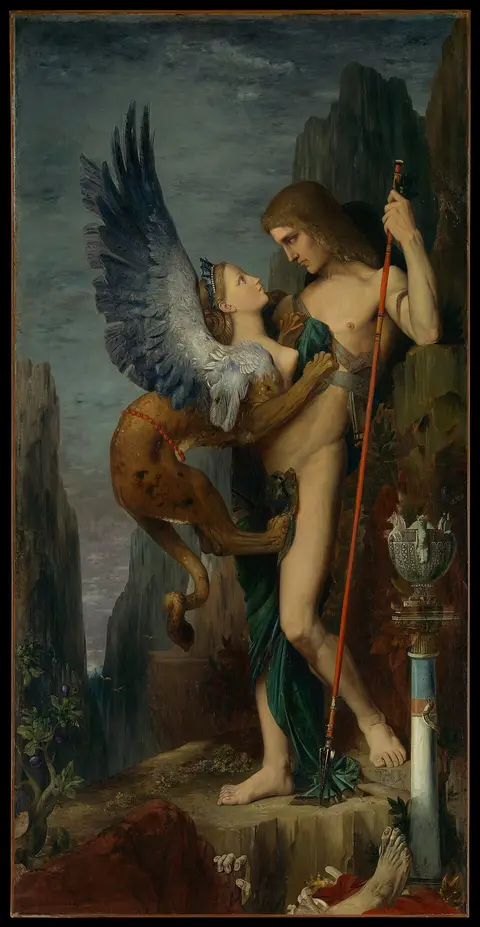
- The Greek sphinx differs from the male-headed sphinxes of Egypt: she has a woman's head, a lion's body and wings.
- According to Apollodorus, Hera sends her to Thebes. She sits on a mountain near the city and asks a riddle the Muses taught her.
- The riddle: 'What has one voice and is four-footed, two-footed and three-footed?' Oedipus gives the right answer: man, who crawls as a baby, walks on two feet as an adult and leans on a stick in old age.
Family
To see the whole family, open the Sphinx family tree → · how is Sphinx related to Zeus? → · compare with someone else →
Whose child?
Hesiod, who calls her Phix, makes the Sphinx the child of Echidna and the dog Orthrus. Apollodorus makes her the child of Typhon and Echidna.
Hesiod, Theogony 326; Apollodorus, Library 3.5.8Sphinx in art
4works depicting Sphinx, in date order, from ancient vases to paintings of the Renaissance and after. All are in the public domain or openly licensed. Click an image for the full-size version and licence details. For scene-by-scene readings of famous vases, see Greek vase painting.


Stories featuring Sphinx
Quick questions
- Who are Sphinx's parents?
- In the main account, Sphinx's father is Typhon and mother is Echidna. Other accounts name other parents; the family box above lists them all with their sources. Apollodorus, Library 3.5.8
- What are Sphinx's symbols?
- Woman's head, Lion's body, Wings.
- Which myths is Sphinx in?
- The curse of Thebes: from Cadmus to Oedipus.
Ancient sources
This page is based on the texts below. Numbers refer to books and lines.
- Hesiod, Theogony 326–327
- Apollodorus, Library 3.5.8
- Sophocles, Oedipus the King 391–398