The hero who tamed the winged horse Pegasus and killed the fire-breathing Chimera in Lycia. Most of his story takes place in Anatolia.
In brief
- The son of Glaucus, king of Corinth, and so the grandson of Sisyphus. In some accounts his real father is Poseidon.
- The wife of Proetus, king of Tiryns, desires him and, when he rejects her, accuses him. Proetus will not kill a guest himself, so he sends him to his father-in-law, the king of Lycia, with a sealed tablet that says 'kill this man'.
- The king of Lycia sets him deadly tasks: to kill the Chimera and fight the Solymi and the Amazons. Bellerophon survives them all, and in the end the king gives him his daughter.
Family
Parents
Homer, Iliad 6.154–155; Apollodorus, Library 1.9.3
Hesiod, Catalogue of Women fr. 43a; Pindar, Olympian 13.69
Consorts and partners
Children
To see the whole family, open the Bellerophon family tree → · how is Bellerophon related to Zeus? → · compare with someone else →
The first trace of writing in Homer
In the Iliad, what Proetus sends with Bellerophon is 'deadly signs scratched on a folded tablet'. It is the only reference to writing, or anything like it, in Homer's epics.
Homer, Iliad 6.155–195Pegasus, and the flight to heaven
Pindar says Bellerophon tamed Pegasus at the spring of Peirene in Corinth, with a golden bridle Athena gave him in a dream. After all his triumphs he tried to fly to Olympus on Pegasus, and Pegasus threw him. Homer says Bellerophon ended his life hated by the gods, alone and shunning other people.
Pindar, Olympian 13.63–92; Pindar, Isthmian 7.44–47; Homer, Iliad 6.200–202The Chimera and Yanartaş
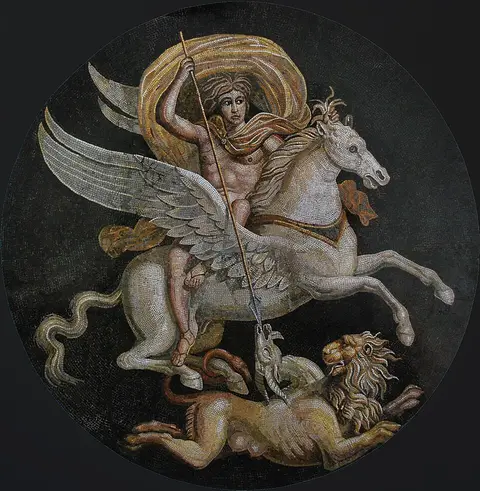
The Chimera is a lion in front, a goat in the middle and a serpent behind, and breathes fire. Ancient writers placed her in Lycia. Pliny mentions a Mount Chimaera near Phaselis that burns day and night. This is Yanartaş, above the village of Çıralı near Kemer in Antalya, where natural gas from the ground has been burning for thousands of years.
Homer, Iliad 6.179–183; Hesiod, Theogony 319–325; Pliny, Natural History 2.236Bellerophon in art
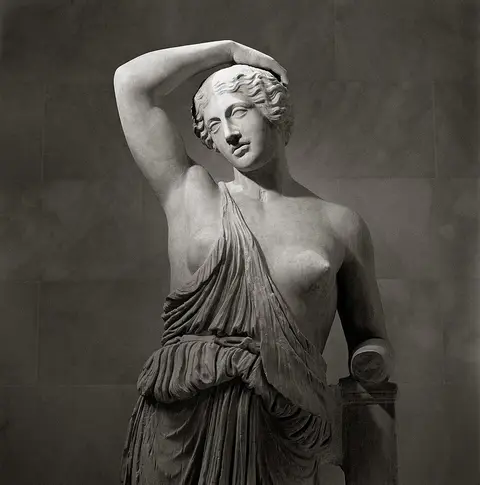
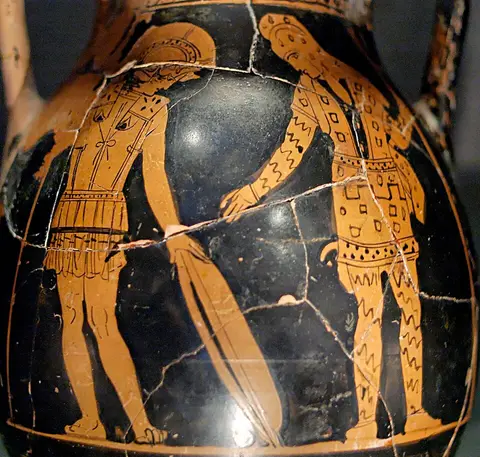
6works depicting Bellerophon, in date order, from ancient vases to paintings of the Renaissance and after. All are in the public domain or openly licensed. Click an image for the full-size version and licence details. For scene-by-scene readings of famous vases, see Greek vase painting.


Stories featuring Bellerophon
Quick questions
- How did Bellerophon kill the Chimera?
- King Proetus sent him to Lycia carrying a sealed tablet that told the Lycian king to kill him. The king gave him deadly tasks instead: to kill the fire-breathing Chimera and to fight the Solymi and the Amazons. Riding Pegasus, Bellerophon survived them all and married the king's daughter. Bellerophon and the Chimera → Homer, Iliad 6.155–195; Pindar, Olympian 13.63–92
- What happened to Bellerophon in the end?
- In Pindar he tries to ride Pegasus up to Olympus and is thrown off. Homer says he ended his life hated by the gods, wandering alone and avoiding other people. Pindar, Isthmian 7.44–47; Homer, Iliad 6.200–202
- Where is the Chimera's fire?
- Pliny describes a "Mount Chimaera" near Phaselis that burns day and night. The place is now known as Yanartaş, above the village of Çıralı near Antalya in Turkey, where natural gas escaping from the ground has burned for thousands of years. Pliny, Natural History 2.236
- Who are Bellerophon's parents?
- In the main account, Bellerophon's father is Glaucus and mother is Eurymede. Other accounts name other parents; the family box above lists them all with their sources. Homer, Iliad 6.154–155; Apollodorus, Library 1.9.3
- Who were Bellerophon's consorts and lovers?
- The partners named in the sources: Philonoe.
- Who are Bellerophon's children?
- This atlas records 2 children of Bellerophon: Laodameia and Hippolochus. See the family tree →
- What are Bellerophon's symbols?
- Pegasus, Golden bridle, Spear.
- Which myths is Bellerophon in?
- Bellerophon and the Chimera · The Amazons: warrior women of the Black Sea · Glaucus and Diomedes: friendship on the battlefield.
Ancient sources
This page is based on the texts below. Numbers refer to books and lines.
- Homer, Iliad 6.144–211
- Pindar, Olympian 13
- Apollodorus, Library 2.3.1–2.3.2