The curse of the house of Atreus
A chain of revenge that runs for five generations, from Tantalus, who tested the gods, down to Agamemnon and Orestes. The greatest trilogy of the ancient theatre tells this family's story.
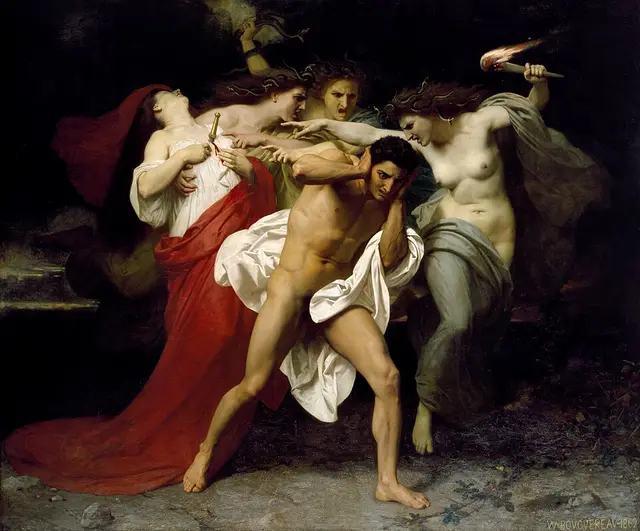
William-Adolphe Bouguereau · Public domain · Wikimedia Commons
In this story
-
Tantalus's table
Tantalus, king of Sipylus, was a mortal who dined with the gods. In one version, to test them, he kills his son Pelops, cooks him and serves him to them. The gods see through it. Only Demeter, lost in grief for her daughter, eats a piece of shoulder. The gods bring Pelops back to life and give him an ivory shoulder in place of the missing one.
Pindar rejects this story as unworthy of the gods. Everyone knows Tantalus's punishment, though: endless hunger and thirst in the underworld.
Pindar, Olympian 1.24–64; Homer, Odyssey 11.582–592 -
Pelops and the chariot race
Oenomaus, king of Pisa, challenges his daughter Hippodamia's suitors to a chariot race, beats them and kills them. Pelops bribes the king's charioteer, Myrtilus, who replaces the wheels' linchpins with wax. The king dies in the race. Pelops breaks his promise and throws Myrtilus into the sea, and as he dies Myrtilus curses Pelops's line.
Pindar says Pelops came from Lydia. The Peloponnese, Greece's southern peninsula, means 'the island of Pelops'.
Apollodorus, Epitome 2.3–2.9; Pindar, Olympian 1.24 -
Thyestes' feast
Atreus and Thyestes, the sons of Pelops, fight over the throne of Mycenae. Thyestes seduces Atreus's wife. In revenge Atreus kills Thyestes' children, cooks them and serves them to his brother at a feast held in the name of reconciliation.
Thyestes' surviving son, Aegisthus, will one day take revenge on the house of Atreus.
Apollodorus, Epitome 2.10–2.14; Aeschylus, Agamemnon 1583–1602 -
Agamemnon's homecoming
Agamemnon, son of Atreus, agrees to sacrifice his daughter Iphigenia so that the winds will blow for the army sailing to Troy. When he returns in triumph ten years later, his wife Clytemnestra and her lover Aegisthus murder him in his bath.
In the Odyssey, Agamemnon's shade tells this to Odysseus in the land of the dead, and warns him to be careful when he gets home.
Aeschylus, Agamemnon; Homer, Odyssey 11.405–434 -
Orestes and the first court
Years later, at Apollo's command, Agamemnon's son Orestes comes home. With the help of his sister Electra he kills his mother and Aegisthus. For killing his mother he is pursued by the Erinyes, the Furies.
In the last play of Aeschylus's trilogy Orestes takes refuge in Athens. Athena sets up a court of citizens on the Areopagus. The votes are tied, and Athena's vote acquits Orestes. The Furies become the protectors of Athens under the name Eumenides, 'the Kindly Ones'. The court takes the place of the blood feud.
Aeschylus, The Libation Bearers; Aeschylus, Eumenides
This story on Greek vases
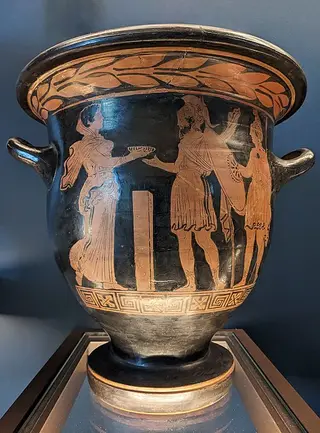
What each painter chose to show, scene by scene: Greek vase painting →
Ancient sources
- Aeschylus, Oresteia (Agamemnon, The Libation Bearers, Eumenides)
- Apollodorus, Epitome 2.1–2.16, 6.23–6.28
- Homer, Odyssey 3.193–310, 11.405–434
- Pindar, Olympian 1
- Sophocles and Euripides, Electra