The son of Thyestes by his own daughter Pelopia, born to avenge his father. He kills first Atreus, then, with Clytemnestra, Agamemnon. He is killed by Orestes.
In brief
- Hyginus says Pelopia abandoned the baby. A shepherd found him and he was suckled by a goat, which is why his name was explained as 'goat strength' (aix).
- Atreus has married Pelopia and raises the child as his own. Later he tells Aegisthus to kill Thyestes. Through the sword his mother had kept, Aegisthus learns that Thyestes is his father, and kills Atreus instead.
- While Agamemnon is at Troy, he becomes Clytemnestra's lover.
Family
Parents
Hyginus, Fabulae 87–88; Apollodorus, Epitome 2.14
Consorts and partners
Siblings
½ Half-sibling: only one parent in common.
To see the whole family, open the Aegisthus family tree → · how is Aegisthus related to Zeus? → · compare with someone else →
The man who was warned
The Odyssey first mentions Aegisthus in a speech by Zeus. Mortals, Zeus complains, blame the gods for their troubles, when their own folly is to blame. He gives Aegisthus as an example: the gods sent Hermes to warn him not to kill Agamemnon. Aegisthus would not listen, and paid for it at the hands of Orestes.
After killing Agamemnon he rules Mycenae for seven years. In the eighth Orestes returns from Athens and kills him.
Homer, Odyssey 1.32–43, 3.303–310Aegisthus in art
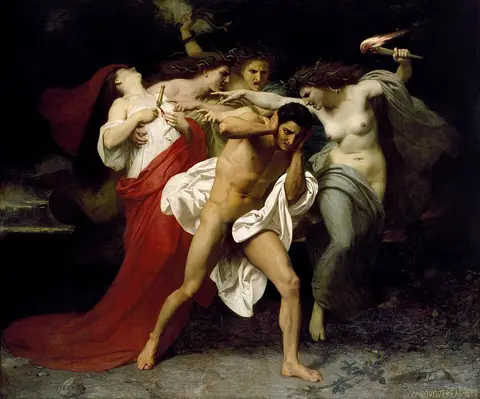
2works depicting Aegisthus, in date order, from ancient vases to paintings of the Renaissance and after. All are in the public domain or openly licensed. Click an image for the full-size version and licence details. For scene-by-scene readings of famous vases, see Greek vase painting.


Stories featuring Aegisthus
Quick questions
- Who are Aegisthus' parents?
- In the main account, Aegisthus' father is Thyestes and mother is Pelopia. Hyginus, Fabulae 87–88; Apollodorus, Epitome 2.14
- Who were Aegisthus' consorts and lovers?
- The partners named in the sources: Clytemnestra.
- Which myths is Aegisthus in?
- The curse of the house of Atreus.
Ancient sources
This page is based on the texts below. Numbers refer to books and lines.
- Homer, Odyssey 1.32–43, 3.193–310, 4.512–537
- Aeschylus, Agamemnon
- Hyginus, Fabulae 87–88
- Apollodorus, Epitome 2.14, 6.23–6.25