The madness of Ajax: the armour of Achilles
After Achilles dies, his armour is to go to the greatest of the Greeks. Ajax and Odysseus both claim it, and it goes to Odysseus. His honour wounded, Ajax is driven to madness and finally falls on his own sword.
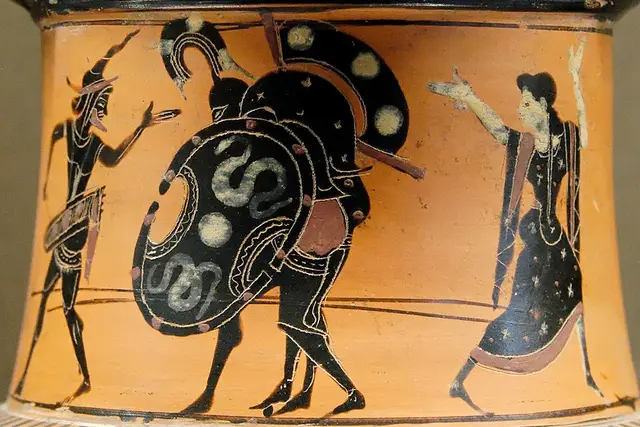
In this story
-
The contest for the armour
In the Odyssey, the sons of the Trojans and Athena decide who will have Achilles' armour. In the lost epic Little Iliad, the Greeks eavesdrop on the Trojans beneath the walls of Troy, and hear a Trojan girl say that Ajax carried Achilles' body but Odysseus did more.
In Ovid, Ajax and Odysseus each make a speech before the commanders. Ajax relies on his strong arms, Odysseus on his wits. The armour goes to Odysseus.
Homer, Odyssey 11.543–551; Little Iliad (summary by Proclus); Ovid, Metamorphoses 13.1–383 -
The slaughter of the flocks
In Sophocles' Ajax, Ajax sets out at night to kill the commanders. Athena clouds his mind, and he butchers the army's flocks, thinking they are the commanders, and whips a ram he takes for Odysseus.
In the morning he comes to his senses, sees what he has done and cannot bear the shame. He fixes in the ground the sword Hector once gave him and falls on it.
Agamemnon and Menelaus want to forbid his burial. At the end of the play it is his enemy Odysseus who speaks up for him.
Sophocles, Ajax -
A flower from blood
Ovid says a purple flower sprang from the earth where Ajax's blood was spilt, the same flower that once grew from the blood of Hyacinthus, whom Apollo loved. On its petals can be read both 'AI AI', the cry of grief for Hyacinthus, and the first letters of the name of Ajax (Aias in Greek).
In the Odyssey, Odysseus wants to speak to the shade of Ajax in the land of the dead. Ajax turns away without a word.
Ovid, Metamorphoses 13.391–398; Homer, Odyssey 11.543–564
This story on Greek vases
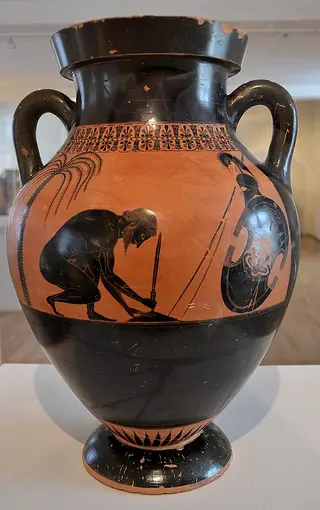
What each painter chose to show, scene by scene: Greek vase painting →
Ancient sources
- Sophocles, Ajax
- Homer, Odyssey 11.543–564
- Ovid, Metamorphoses 13.1–398
- Apollodorus, Epitome 5.6–5.7
- Pindar, Nemean 8.23–34