The eldest son of Priam and the greatest Trojan warrior. He kills Patroclus and is killed in turn by Achilles in front of the walls of Troy.
Who fought for whom in the Trojan War? Play →
In brief
- The eldest son of Priam and Hecuba. His wife is Andromache and their baby son is Astyanax.
- Patroclus goes into battle wearing Achilles's armour. Hector kills him and takes the armour, and Achilles returns to the fighting to avenge his friend.
- Achilles kills Hector in front of the walls of Troy and drags his body behind his chariot. Old Priam goes to Achilles's tent at night and ransoms his son's body.
Family
Consorts and partners
Children
To see the whole family, open the Hector family tree → · how is Hector related to Zeus? → · compare with someone else →
The baby who was afraid of the helmet
In one of the best-known scenes of the Iliad, Hector says goodbye to his wife and son on the walls before going back to battle. The baby Astyanax is frightened by his father's gleaming, horsehair-crested helmet and cries. Hector and Andromache laugh; Hector takes off the helmet, sets it on the ground and takes his son in his arms.
Homer, Iliad 6.390–502The last line of the Iliad
The Iliad begins with the anger of Achilles but ends with the funeral of Hector. Its last line is: 'Such were the funeral rites of Hector, tamer of horses.' Andromache was a princess of Thebe under Mount Placus, near the Gulf of Edremit; her father and brothers had been killed when Achilles sacked the city.
Homer, Iliad 24.804; 6.395–397, 6.414–424Words of Hector
“No man escapes his fate, whether coward or brave. That is how it has been since the day he was born.”
“One day, as he comes home from war, let someone say of him: “He is far better than his father.””
Our own plain translations: they keep the sense, not the exact words. Play “Who said it?” →
Hector on Greek vases
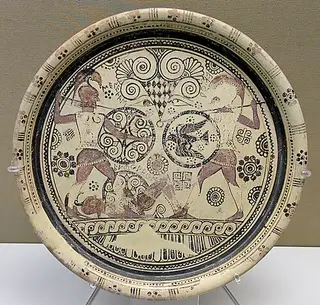
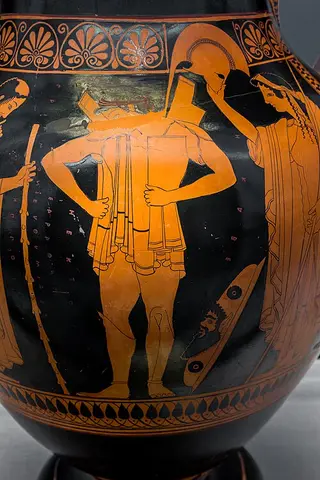
Hector in art
16works depicting Hector, in date order, from ancient vases to paintings of the Renaissance and after. All are in the public domain or openly licensed. Click an image for the full-size version and licence details. For scene-by-scene readings of famous vases, see Greek vase painting.


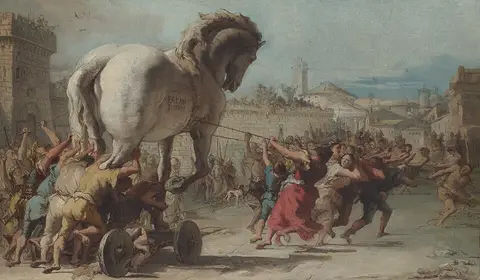
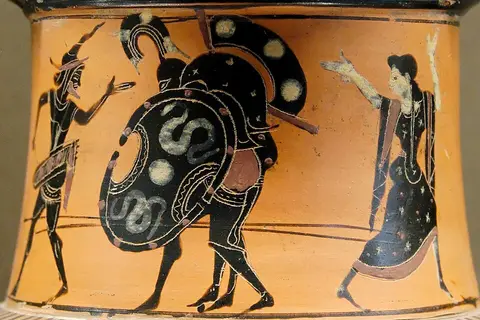
Stories featuring Hector
Quick questions
- Who are Hector's parents?
- In the main account, Hector's father is Priam and mother is Hecuba. Homer, Iliad 6.87, 22.79–89; Apollodorus, Library 3.12.5
- Who were Hector's consorts and lovers?
- The partners named in the sources: Andromache.
- Who are Hector's children?
- This atlas records 2 children of Hector: Astyanax and Astyanacs. See the family tree →
- What are Hector's symbols?
- Helmet with horsehair crest.
- Which myths is Hector in?
- The Trojan War · The madness of Ajax: the armour of Achilles.
Ancient sources
This page is based on the texts below. Numbers refer to books and lines.
- Homer, Iliad 6, 16, 22, 24
- Apollodorus, Epitome 4.1–4.8