Queen of Troy and wife of Priam, who loses almost all her children in the war. In tragedy she is the image of suffering; legend says she became a dog, and her grave was shown on the Gallipoli peninsula.
In brief
- In the Iliad she is the daughter of Dymas, a Phrygian king. She is Priam's wife and the mother of Hector, Paris, Cassandra and Polydorus.
- Before giving birth to Paris she dreams that she is bearing a burning torch that sets Troy on fire.
- When Troy falls she is given as a captive to Odysseus.
Family
Parents
Homer, Iliad 16.717–719; Apollodorus, Library 3.12.5
Daughter of Cisseus
Euripides, Hecuba 3; Apollodorus, Library 3.12.5
Consorts and partners
Children
* Only in some accounts.
To see the whole family, open the Hecuba family tree → · how is Hecuba related to Zeus? → · compare with someone else →
Euripides's Hecuba
Before Troy fell, Priam entrusted his youngest son Polydorus, along with treasure, to Polymestor, king of Thrace. After the war Polymestor seizes the treasure, kills the boy and throws his body into the sea. The captive Hecuba sees her son's body wash ashore. She lures Polymestor into her tent with a trick, kills his sons and blinds him.
Euripides, HecubaThe dog's grave
Euripides and Ovid say Hecuba was finally turned into a fiery-eyed dog. Strabo writes that a place called Cynossema, 'the dog's grave', near Madytus (Eceabat) on the European shore of the Dardanelles, was shown as Hecuba's tomb. This is the coast between Kilitbahir and Eceabat, the narrowest point of the strait.
Euripides, Hecuba 1259–1273; Ovid, Metamorphoses 13.565–571; Strabo, Geography 13.1.28Hecuba on Greek vases
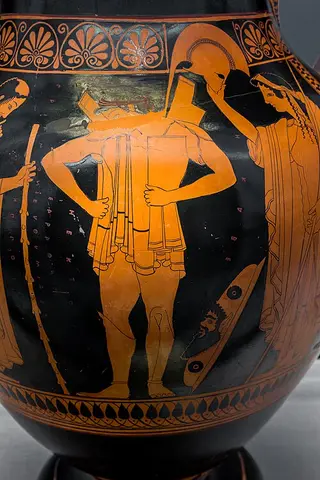
Hecuba in art
8works depicting Hecuba, in date order, from ancient vases to paintings of the Renaissance and after. All are in the public domain or openly licensed. Click an image for the full-size version and licence details. For scene-by-scene readings of famous vases, see Greek vase painting.


Stories featuring Hecuba
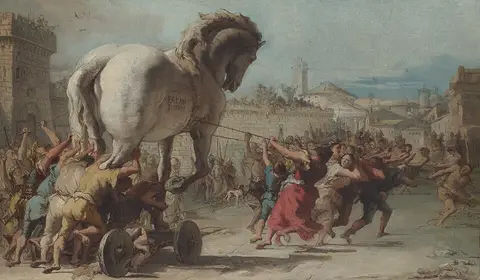
Quick questions
- Who are Hecuba's parents?
- In the main account, Hecuba's father is Dymas. The mother is not named in this account. Other accounts name other parents; the family box above lists them all with their sources. Homer, Iliad 16.717–719; Apollodorus, Library 3.12.5
- Who were Hecuba's consorts and lovers?
- The partners named in the sources: Priam.
- Who are Hecuba's children?
- This atlas records 8 children of Hecuba: Deiphobus, Hector, Helenus, Cassandra, Paris, Polyxena, Troilus and Creusa. See the family tree →
- Which myths is Hecuba in?
- The Trojan War.
Ancient sources
This page is based on the texts below. Numbers refer to books and lines.
- Homer, Iliad 6.251–311, 22.79–89, 24.747–760
- Apollodorus, Library 3.12.5 (the dream); Epitome 5.23
- Euripides, Hecuba; Trojan Women 277–278
- Ovid, Metamorphoses 13.399–575