Trojan princess and prophetess. Apollo gives her the gift of foresight, then curses her so that no one will believe her. She sees the fall of Troy coming but cannot convince anyone.
In brief
- The daughter of Priam and Hecuba.
- In Aeschylus, Apollo gives her the gift of prophecy, but she breaks the promise she made in return. As a punishment, Apollo makes sure no one will ever believe her prophecies.
- She tells the Trojans that the wooden horse is a trap. No one listens.
Family
Consorts and partners
To see the whole family, open the Cassandra family tree → · how is Cassandra related to Zeus? → · compare with someone else →
The night Troy fell
As the city falls, Cassandra takes refuge in the temple of Athena and clings to the goddess's statue. The lesser Ajax drags her away from it by force. Because of this sacrilege Athena sends a storm against the Greek fleet on its way home.
Apollodorus, Epitome 5.22, 6.5–6.6Her last prophecy, at Mycenae
Cassandra is given to Agamemnon as a prize. In Aeschylus's tragedy, in front of the palace of Mycenae, she foresees her own death and Agamemnon's. The chorus does not understand her. She walks into the palace knowing what awaits her, and is killed by Clytemnestra. Today a 'Cassandra' is someone whose warnings are right but go unheeded.
Aeschylus, Agamemnon 1035–1330; Homer, Odyssey 11.421–423Words of Cassandra
“Apollo, Apollo! God of the ways, my destroyer!”
Our own plain translations: they keep the sense, not the exact words. Play “Who said it?” →
Cassandra on Greek vases
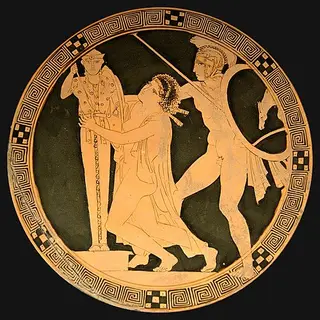
Cassandra in art
10works depicting Cassandra, in date order, from ancient vases to paintings of the Renaissance and after. All are in the public domain or openly licensed. Click an image for the full-size version and licence details. For scene-by-scene readings of famous vases, see Greek vase painting.


Quick questions
Ancient sources
This page is based on the texts below. Numbers refer to books and lines.
- Homer, Iliad 13.365–369, 24.697–706
- Aeschylus, Agamemnon 1035–1330
- Euripides, Trojan Women
- Apollodorus, Library 3.12.5; Apollodorus, Epitome 5.17–5.23