The last king of Troy, who loses most of his fifty sons in the war. In the most moving scene of the Iliad he kisses the hands of his enemy Achilles to win back the body of his son Hector.
Who fought for whom in the Trojan War? Play →
In brief
- The son of Laomedon, king of Troy. His wife is Hecuba, and among his children are Hector, Paris, Cassandra and Troilus. In the Iliad he says he had fifty sons.
- Throughout the war he watches the fighting from the walls as an old king. He does not blame Helen; he says the disaster is the work of the gods.
- On the night Troy falls, Achilles's son Neoptolemus kills him at the altar of Zeus where he has taken refuge.
Family
Parents
Homer, Iliad 20.236–237
Consorts and partners
Siblings
To see the whole family, open the Priam family tree → · how is Priam related to Zeus? → · compare with someone else →
The 'bought' child
Apollodorus says Priam's real name was Podarces. When Heracles killed King Laomedon for breaking his word, he spared only one of his sons, Podarces. His sister Hesione bought her brother back with her veil, and from then on his name, linked to the verb 'to buy', was Priam.
Apollodorus, Library 2.6.4In Achilles's tent
After Hector's death, Zeus sends Hermes to guide Priam. At night the old king drives a wagon laden with ransom through the Greek camp and enters Achilles's tent. He kneels and kisses 'the hands that killed my sons'. Achilles thinks of his own old father, and the two weep together, one for his son, the other for his father and for Patroclus. Achilles gives back the body and grants an eleven-day truce for the funeral.
Homer, Iliad 24.468–676'Priam's Treasure'
In 1873 Schliemann found a great hoard of gold and silver at Troy and called it 'Priam's Treasure'. Later research showed that it belongs to the Troy II layer, around 2400 BC, more than a thousand years before Priam's time. Schliemann smuggled most of it out of the Ottoman Empire; it is now in the Pushkin Museum in Moscow.
Words of Priam
“I have done what no other man on earth has done: I have raised to my lips the hand of the man who killed my sons.”
Our own plain translations: they keep the sense, not the exact words. Play “Who said it?” →
Priam on Greek vases
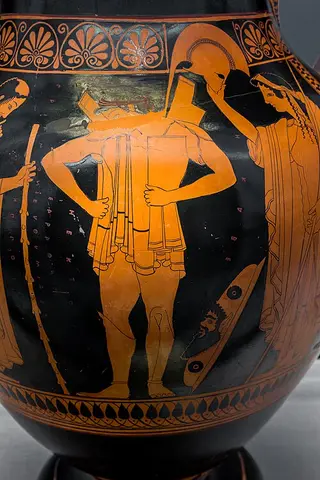
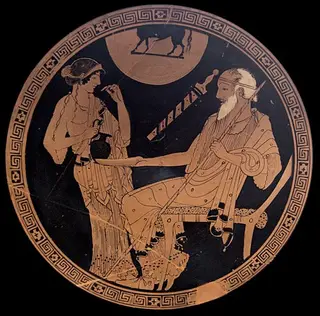
Priam in art
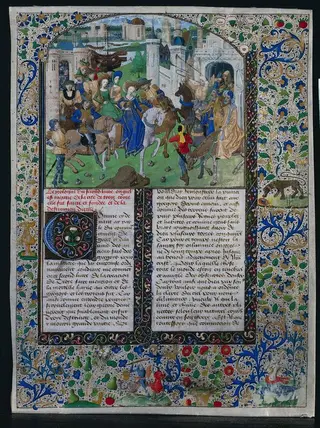
14works depicting Priam, in date order, from ancient vases to paintings of the Renaissance and after. All are in the public domain or openly licensed. Click an image for the full-size version and licence details. For scene-by-scene readings of famous vases, see Greek vase painting.




Stories featuring Priam
Quick questions
- Who are Priam's parents?
- In the main account, Priam's father is Laomedon. The mother is not named in this account. Homer, Iliad 20.236–237
- Who were Priam's consorts and lovers?
- The partners named in the sources: Hecuba.
- Who are Priam's children?
- This atlas records 8 children of Priam: Deiphobus, Hector, Helenus, Cassandra, Paris, Polyxena, Troilus and Creusa. See the family tree →
- What are Priam's symbols?
- Sceptre.
- Which myths is Priam in?
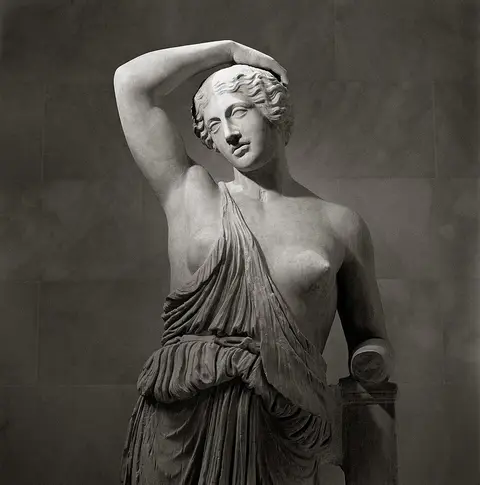
- The Amazons: warrior women of the Black Sea · Eos and Tithonus · Palamedes: the revenge of Odysseus · The Trojan War.
Ancient sources
This page is based on the texts below. Numbers refer to books and lines.
- Homer, Iliad 3.146–244, 22.25–89, 24
- Apollodorus, Library 2.6.4, 3.12.5
- Virgil, Aeneid 2.506–558