Eos and Tithonus
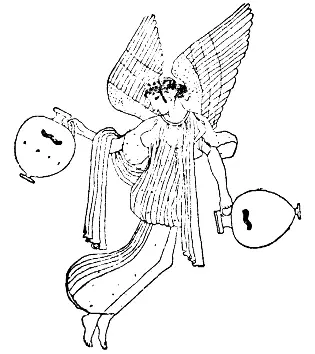
The goddess of dawn asks Zeus to make her Trojan lover immortal, but forgets to ask for eternal youth. Tithonus never dies; he only grows older and older.
In this story
-
A Trojan prince
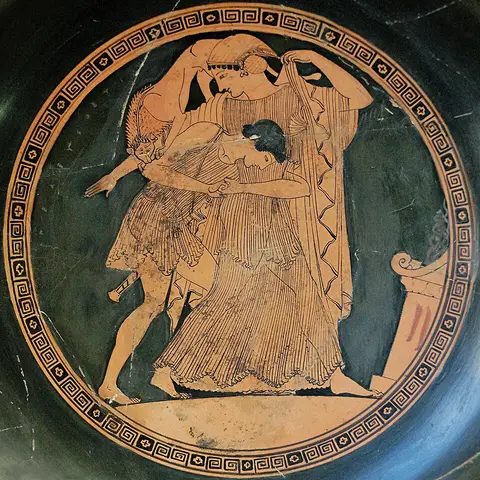
Tithonus is a son of Laomedon, king of Troy, and so a brother of Priam. Eos, goddess of the dawn, falls in love with him and carries him off to her home by the stream of Ocean.
Homer, Iliad 20.237; Homeric Hymn 5 to Aphrodite 218–227 -
The forgotten wish
Eos asks Zeus to make her lover immortal, and Zeus agrees. But she has forgotten to ask for him to stay young forever.
When Tithonus's hair begins to turn grey, Eos leaves his bed, though she still gives him ambrosia and fine clothes. At last, when he is too old even to move his arms, she shuts him away in a room. From it comes a voice that never stops talking, though all his strength is gone.
In later versions Tithonus finally turns into a cicada.
Homeric Hymn 5 to Aphrodite 218–238 -
Memnon and the dewdrops
Memnon, the son of Eos and Tithonus, is king of the Ethiopians. In the Trojan War he comes to help his uncle Priam, fights Achilles and is killed.
Ovid says that Eos has wept for her son ever since: the dewdrops we see on the leaves in the morning are her tears.
Tennyson's poem 'Tithonus' gives voice to a man who is immortal but ageing, and longs to die.
Hesiod, Theogony 984–985; Ovid, Metamorphoses 13.576–622
Ancient sources
- Homeric Hymn 5 to Aphrodite 218–238
- Homer, Iliad 11.1–2, 20.237
- Sappho, fragment 58
- Ovid, Metamorphoses 13.576–622