Aphrodite and Anchises: the goddess on Mount Ida
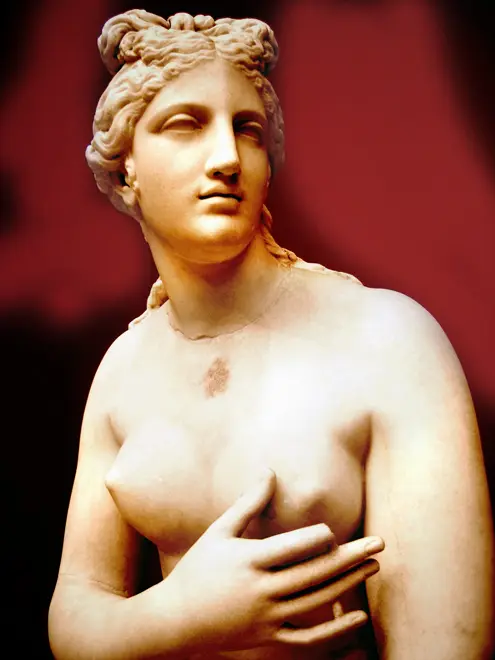
Aphrodite, who makes all the gods fall in love, is made by Zeus to fall for Anchises, a Trojan herding cattle on Mount Ida. She comes to him disguised as a mortal princess. Their son is Aeneas, later claimed as the ancestor of the Romans.
In this story
-
Zeus's trick
The Homeric Hymn says Aphrodite overpowers gods, humans and animals with desire; only Athena, Artemis and Hestia are immune. Even Zeus yields to her and sleeps with mortal women.
To stop her boasting about it, Zeus fills her heart with desire for a mortal: Anchises, as handsome as a god, herding cattle on the high peaks of Mount Ida.
Homeric Hymn to Aphrodite (5) 1–57 -
A Phrygian princess
Aphrodite goes to her temple at Paphos in Cyprus, where the Graces bathe and adorn her. Then she climbs Ida, mother of wild beasts; wolves, lions, bears and leopards follow her fawning.
She appears to Anchises as a young girl. He suspects she is a goddess, but she says she is the daughter of Otreus, king of Phrygia, carried off by Hermes from a dance of Artemis's companions; she speaks Trojan because a Trojan nurse raised her. Anchises believes her, and they sleep together.
Homeric Hymn to Aphrodite (5) 58–167 -
The goddess revealed
While Anchises sleeps, Aphrodite takes on her true form and wakes him. Terrified, he hides his face: a man who sleeps with a goddess, he fears, will lose his strength. She calms him.
She tells him that others of his family have been loved by gods: Ganymede, whom Zeus carried off and made immortal, and Tithonus, for whom the Dawn goddess Eos asked immortality but forgot to ask youth. She does not want that fate for Anchises.
Homeric Hymn to Aphrodite (5) 168–246 -
Aeneas and the secret
Aphrodite tells him their son will be called Aeneas. The mountain nymphs will raise him until he is five and then bring him to Anchises, who must say the child's mother is a nymph.
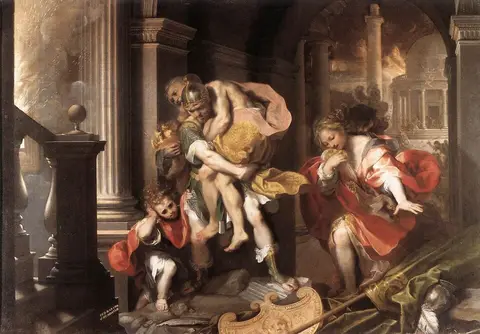
She warns him: if he ever boasts that he slept with a goddess, Zeus will strike him with a thunderbolt. Later writers say Anchises boasted while drunk and was struck; in Virgil, as Troy falls, his son Aeneas carries him out of the burning city on his back.
Homeric Hymn to Aphrodite (5) 247–291; Hyginus, Fabulae 94; Virgil, Aeneid 2.634–720
Ancient sources
- Homeric Hymn to Aphrodite (5)
- Homer, Iliad 2.819–821, 5.311–313
- Hyginus, Fabulae 94