A Trojan prince who lived on the slopes of Mount Ida. Because he was the most beautiful of mortals, the gods took him up to heaven, where he became the cupbearer of the gods on Olympus.
In brief
- He is the son of Tros, the king who gave the Trojans their name.
- The Iliad says the gods carried him off for his beauty to pour wine for Zeus. In the Homeric Hymn to Aphrodite, Zeus snatches him away in a whirlwind and gives his grieving father immortal horses as a consolation.
- In later accounts Zeus takes the form of an eagle, or sends his eagle, and carries him off from Mount Ida.
Family
Parents
Homer, Iliad 20.231–235
Siblings
To see the whole family, open the Ganymede family tree → · how is Ganymede related to Zeus? → · compare with someone else →
Ganymede in the sky
Jupiter's moon Ganymede is the largest moon in the Solar System, bigger even than the planet Mercury. In some accounts the constellation Aquarius, the water-bearer, is Ganymede pouring drink for the gods.
Eratosthenes, Catasterismi (Aquarius)Ganymede in art
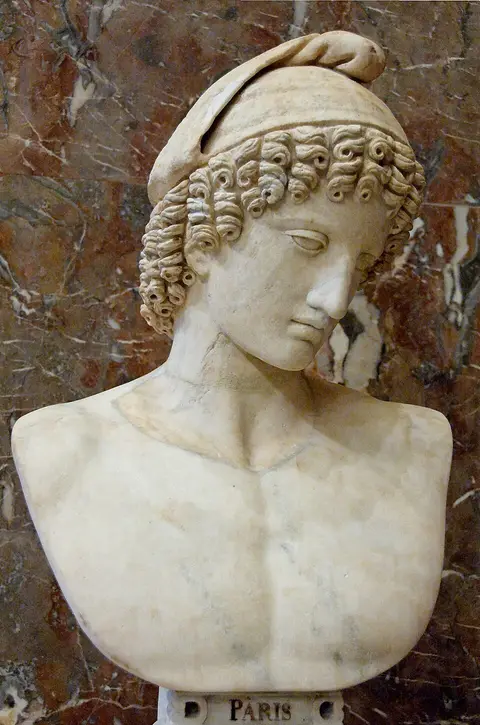
16works depicting Ganymede, in date order, from ancient vases to paintings of the Renaissance and after. All are in the public domain or openly licensed. Click an image for the full-size version and licence details. For scene-by-scene readings of famous vases, see Greek vase painting.


Stories featuring Ganymede
Quick questions
- Who are Ganymede's parents?
- In the main account, Ganymede's father is Tros. The mother is not named in this account. Homer, Iliad 20.231–235
- What is Ganymede's Roman name?
- In Roman mythology Ganymede is known as Catamitus. All Greek and Roman names →
- What are Ganymede's symbols?
- Eagle, Cup.
- Which myths is Ganymede in?
- The abduction of Ganymede: from Mount Ida to Olympus · Aphrodite and Anchises: the goddess on Mount Ida.
Ancient sources
This page is based on the texts below. Numbers refer to books and lines.
- Homer, Iliad 5.265–267, 20.231–235
- Homeric Hymn 5 to Aphrodite 202–217
- Ovid, Metamorphoses 10.155–161