The journey of Telemachus: the son who went looking for his father
The first four books of the Odyssey are not about Odysseus but about his son Telemachus. Guided by Athena, the young man secretly leaves Ithaca to find news of his father. He visits old Nestor at Pylos and Menelaus and Helen at Sparta, while the suitors lay an ambush to kill him on his way home.
In this story
-
Athena disguised as Mentes
Years have passed since Odysseus left for Troy. His house on Ithaca is full of Penelope's suitors, who eat and drink their way through his wealth. Telemachus is now a young man, but he cannot control them.
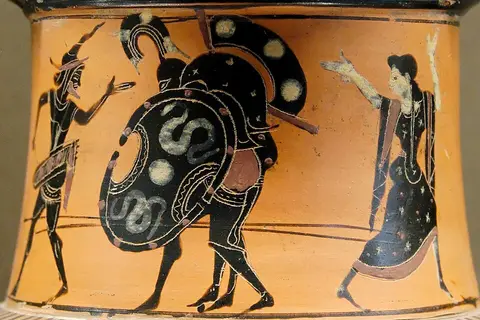
Athena comes to the house disguised as Mentes of Taphos, an old guest-friend of his father. She gives Telemachus courage and some advice: he should fit out a ship and sail to Nestor at Pylos, and from there to Menelaus at Sparta. If his father is alive, he should wait one more year; if he is dead, he should mourn him.
Homer, Odyssey 1.96–324 -
The assembly on Ithaca
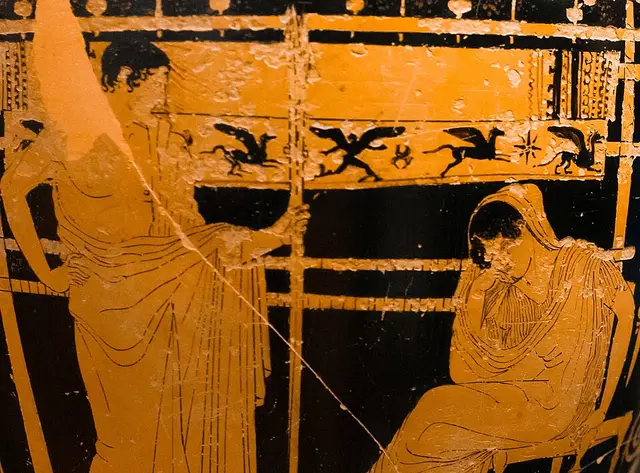
For the first time since Odysseus left, Telemachus calls the people to an assembly and demands that the suitors leave his house. The suitor Antinous blames Penelope: for three years she put them off by weaving a shroud for her father-in-law Laertes and secretly unpicking it at night.
Then Zeus sends two eagles, which tear at each other above the assembly. The seer Halitherses reads this as a sign that Odysseus will soon return and that disaster awaits the suitors. They will not listen.
Athena finds a ship and a crew for the voyage, then boards with Telemachus disguised as Mentor, an old friend of Odysseus. The nurse Eurycleia prepares provisions. Telemachus sets sail by night without telling his mother.
Homer, Odyssey 2.1–434 -
Nestor at Pylos
When they reach Pylos they find the people on the shore sacrificing bulls to Poseidon. The old king Nestor welcomes them. He does not know where Odysseus is, but he tells of the homecomings from Troy: how Agamemnon was killed in his own house by Aegisthus, and how his son Orestes avenged his father.
As she leaves, Athena, still disguised as Mentor, turns into a bird and flies away. Nestor realises his guest was a god. The next day Nestor's son Pisistratus sets out with Telemachus by chariot for Sparta.
Homer, Odyssey 3.1–497 -
Menelaus and Helen at Sparta
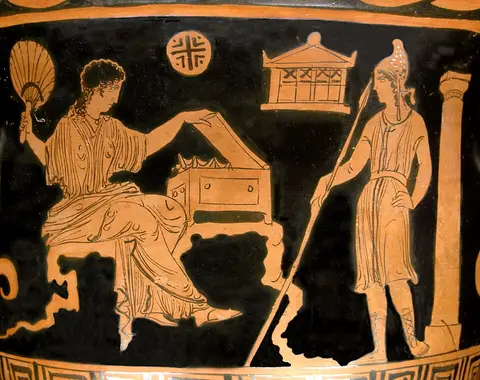
There is a double wedding at Menelaus's palace: his daughter Hermione is to marry Neoptolemus, the son of Achilles. Helen recognises Telemachus at once by his likeness to his father.
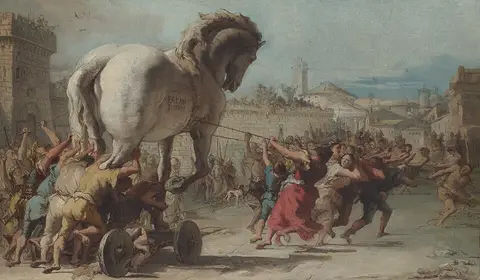
When they all begin to weep at the memory of Odysseus, Helen mixes into the wine a drug she brought from Egypt that makes people forget pain and anger. Then she tells how Odysseus slipped into Troy disguised as a beggar. Menelaus tells of the night spent inside the wooden horse.
Menelaus tells how, on his way home from Egypt, he was stranded without wind on the island of Pharos. On the advice of Eidothea, daughter of the old man of the sea Proteus, he hid under sealskins and seized Proteus. Proteus turned into a lion, a snake, water and a tree, but Menelaus held on. At last Proteus spoke: Odysseus is alive. The nymph Calypso keeps him on her island, and he has no ship to sail home.
Homer, Odyssey 4.1–624 -
The suitors' ambush and the return
When the suitors learn that Telemachus has gone, Antinous lies in wait with a ship at the little island of Asteris, in the strait between Ithaca and Samos. Penelope is crushed when she hears the news. Athena sends her a dream in the shape of her sister Iphthime, telling her that her son is under the gods' protection.
Athena tells Telemachus at Sparta that it is time to go home and warns him of the ambush. Telemachus sails by night. On reaching Ithaca he sends the ship on to the town, goes ashore himself and walks to the hut of the swineherd Eumaeus. There he meets his father, disguised as a beggar.
Homer, Odyssey 4.625–847, 15.1–300, 15.495–557, 16.1–234