Son of Tantalus of Lydia. His father serves him to the gods as a meal, and the gods bring him back to life. He wins a kingdom and a wife in a chariot race, and the Peloponnese, 'the island of Pelops', is named after him.
In brief
- The son of Tantalus, king of Sipylus. In one version his father kills him and serves him to the gods. The gods restore him to life, and replace the shoulder that the grieving Demeter had eaten with one of ivory.
- Pindar says Poseidon gave him a golden chariot drawn by winged horses.
- He beats Oenomaus, king of Pisa, in a chariot race and marries his daughter Hippodamia. But to do it he bribed the king's charioteer, Myrtilus, and Myrtilus's curse follows his family for generations.
Family
Parents
Pindar, Olympian 1.24–27
Consorts and partners
Siblings
To see the whole family, open the Pelops family tree → · how is Pelops related to Zeus? → · compare with someone else →
The shrine at Olympia
In the middle of the sanctuary of Zeus at Olympia was an enclosure dedicated to Pelops, the Pelopion. Pausanias says Pelops was honoured above all the heroes at Olympia, and some ancient accounts say the Olympic Games began as a celebration of his victory.
Pausanias, Description of Greece 5.13.1Pelops on Greek vases
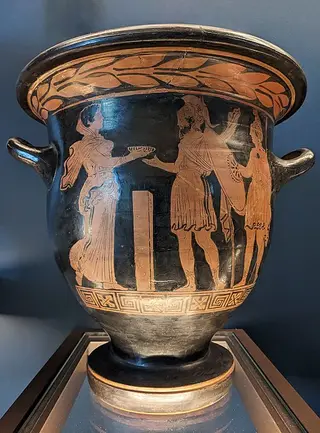
Pelops in art
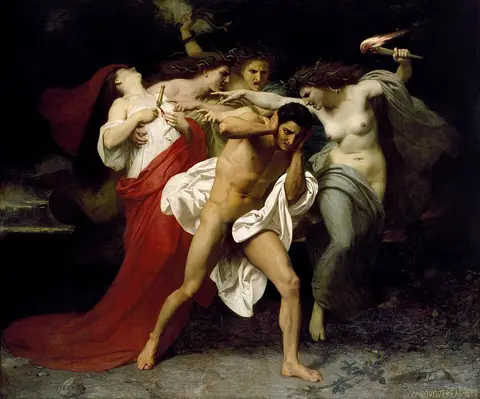
1work depicting Pelops, in date order, from ancient vases to paintings of the Renaissance and after. All are in the public domain or openly licensed. Click an image for the full-size version and licence details. For scene-by-scene readings of famous vases, see Greek vase painting.

Stories featuring Pelops
Quick questions
- Who are Pelops' parents?
- In the main account, Pelops' father is Tantalus. The mother is not named in this account. Pindar, Olympian 1.24–27
- Who were Pelops' consorts and lovers?
- The partners named in the sources: Hippodamia.
- Who are Pelops' children?
- This atlas records 5 children of Pelops: Atreus, Thyestes, Chrysippus, Nicippe and Pittheus. See the family tree →
- What are Pelops' symbols?
- Ivory shoulder, Chariot.
- Which myths is Pelops in?
- The curse of the house of Atreus.
Ancient sources
This page is based on the texts below. Numbers refer to books and lines.
- Pindar, Olympian 1
- Apollodorus, Epitome 2.1–2.10
- Pausanias, Description of Greece 5.13.1–7