Deity · Greek mythology
The foremost of the nine Muses; her name means 'beautiful voice'. Later tradition makes her the Muse of epic poetry. She is the mother of the singer Orpheus.
In brief
- A daughter of Zeus and Mnemosyne, goddess of memory, and one of the nine Muses.
- Hesiod calls her the foremost of the Muses: she attends on revered kings and gives them gentle speech.
- In Apollodorus she bears Orpheus and the singer Linus to Oeagrus (or Apollo).
Family
Siblings
Muses MMelpomene Apollo½ Ares½ Artemis½ Athena½ DDardanus½ Dionysus½ Eileithyia½ Hebe½ Helen½ Heracles½ Hermes½ Horae½ Graces½ Minos½ Fates½ Persephone½ Perseus½ Pollux½ Sarpedon½ Tantalus½ AAmphion½ RRhadamanthys½
½ Half-sibling: only one parent in common.
To see the whole family, open the Calliope family tree → · how is Calliope related to Zeus? → · compare with someone else →
The Muse of epic
Hesiod does not yet give the Muses separate arts. Assigning each Muse her own field became common in later centuries; in that scheme Calliope is the Muse of epic poetry, often shown with a writing tablet. Homer opens both the Iliad and the Odyssey by calling on a Muse without naming her.
Hesiod, Theogony 75–80; Homer, Iliad 1.1; Homer, Odyssey 1.1Stories featuring Calliope
Quick questions
- Who are Calliope's parents?
- In the main account, Calliope's father is Zeus and mother is Mnemosyne. Hesiod, Theogony 53–79
- Who are Calliope's children?
- This atlas records 1 child of Calliope: Orpheus. See the family tree →
- What are Calliope's symbols?
- Writing tablet, Stylus.
- Which myths is Calliope in?
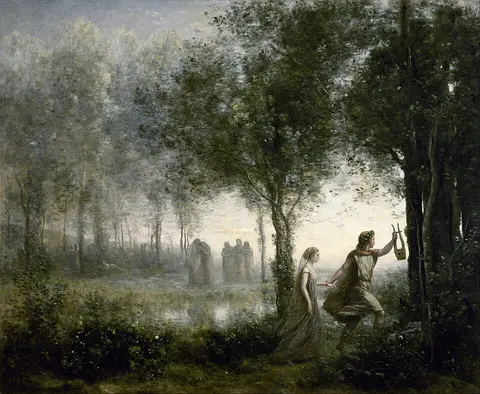
- Orpheus and Eurydice.
Ancient sources
This page is based on the texts below. Numbers refer to books and lines.
- Hesiod, Theogony 53–103
- Apollodorus, Library 1.3.2