Orpheus and Eurydice
The singer whose music could make stones weep goes down to the underworld to bring back his dead wife. There is one condition: he must not look back until they reach the upper world.
In this story
-
The snakebite
Orpheus's young wife Eurydice was bitten by a snake and died. In Virgil she was running from Aristaeus, who was chasing her; in Ovid she was walking in a meadow with the nymphs.
Virgil, Georgics 4.453–459; Ovid, Metamorphoses 10.8–10 -
A song in the land of the dead
Orpheus went down beneath the earth to the land of the dead. Before Persephone and Hades he played his lyre and sang. Ovid says the ghosts wept, Tantalus stopped reaching for the water and Sisyphus sat down on his rock; for the first time, tears ran down the cheeks of the avenging Furies. Hades and Persephone gave Eurydice back to him on one condition: Orpheus must not look back until he reached the upper world.
Ovid, Metamorphoses 10.11–52 -
Looking back
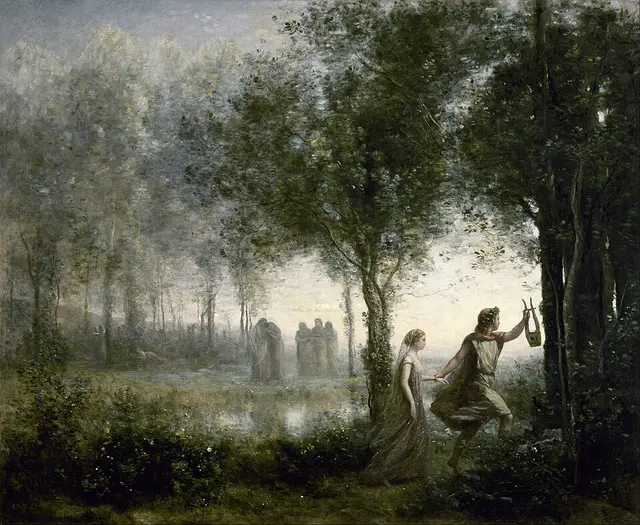
They climbed in silence along the steep, dark path. They were almost out when Orpheus, afraid she was no longer behind him, could not help himself and turned to look. At once Eurydice slipped back. Ovid says her last word was a single 'farewell', which barely reached his ears.
Ovid, Metamorphoses 10.53–63; Virgil, Georgics 4.485–503 -
The singer's end
Orpheus tried to cross into the underworld a second time, but the ferryman Charon would not take him. For years he mourned, kept away from women, and drew trees and animals after him with his songs. In the end he was torn apart by the Thracian women, the frenzied followers of Dionysus. His head and lyre floated down the river Hebrus, still singing, out to sea and on to Lesbos. Ovid says his shade went down to the underworld and found Eurydice there. Now they walk side by side, and Orpheus can look back at her as often as he likes.
Ovid, Metamorphoses 10.72–85, 11.1–66
This story on Greek vases
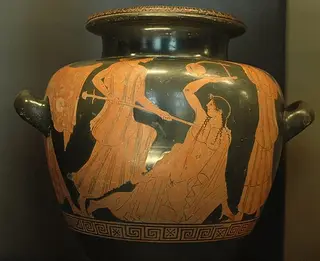
What each painter chose to show, scene by scene: Greek vase painting →
Orpheus and Eurydice: common questions
How did Eurydice die?
From a snakebite, soon after her wedding to Orpheus. In Virgil she was running from Aristaeus; in Ovid she was walking in a meadow with the nymphs.
Virgil, Georgics 4.453–459; Ovid, Metamorphoses 10.8–10Why did Orpheus look back?
Hades and Persephone let Eurydice go on one condition: he must not look back until they reached the upper world. Almost out, afraid she was no longer behind him, he turned, and she slipped back to the dead with a single "farewell".
Ovid, Metamorphoses 10.53–63; Virgil, Georgics 4.485–503What happened to Orpheus in the end?
The Thracian followers of Dionysus tore him apart. His head and lyre floated down the Hebrus, still singing, as far as Lesbos. Ovid gives the story a gentler close: in the underworld he finds Eurydice again and can look at her as often as he likes.
Ovid, Metamorphoses 11.1–66Ancient sources
- Virgil, Georgics 4.453–527
- Ovid, Metamorphoses 10.1–85, 11.1–66
- Apollodorus, Library 1.3.2